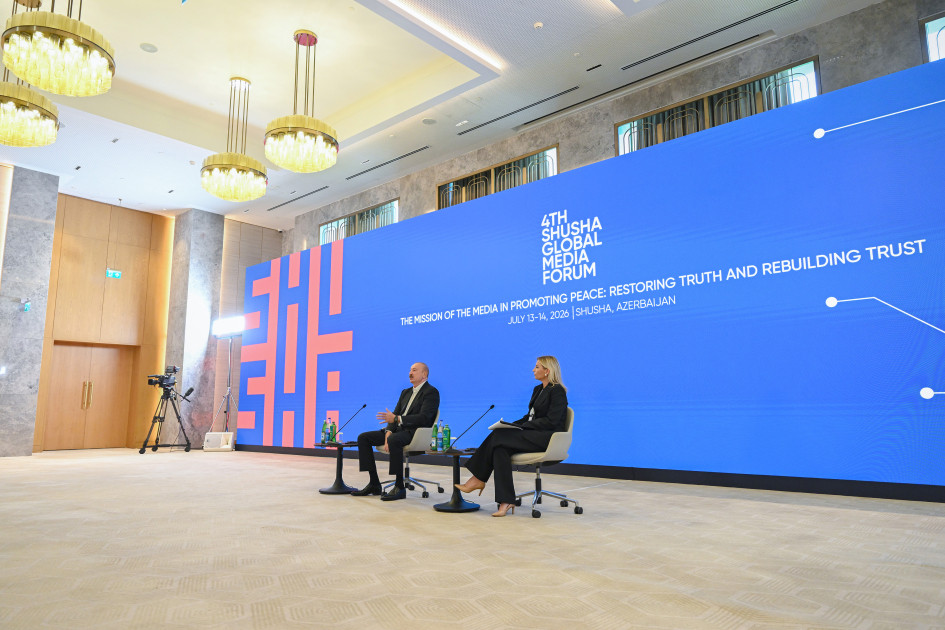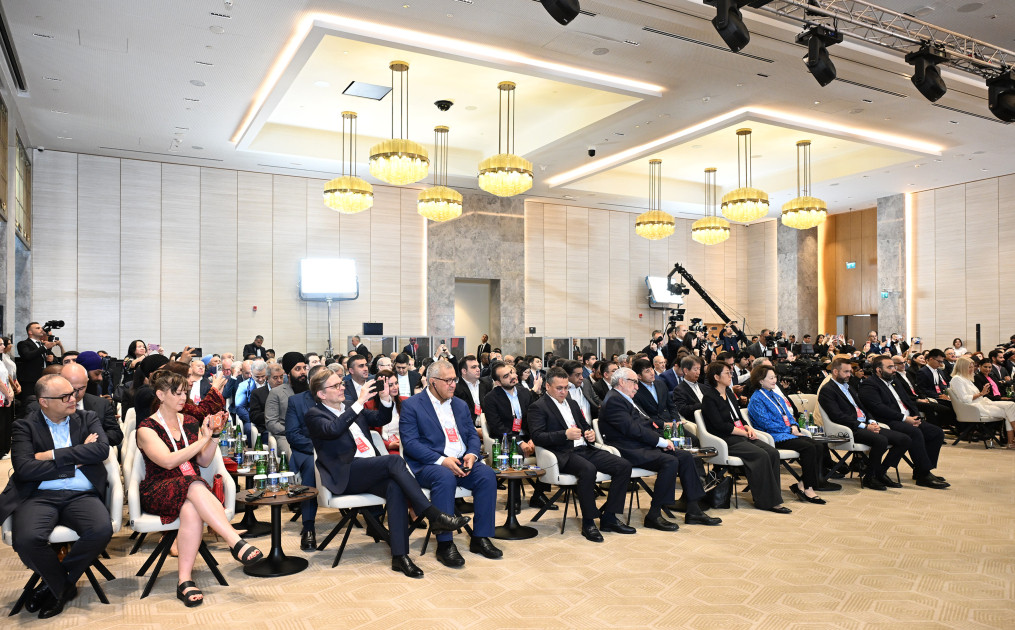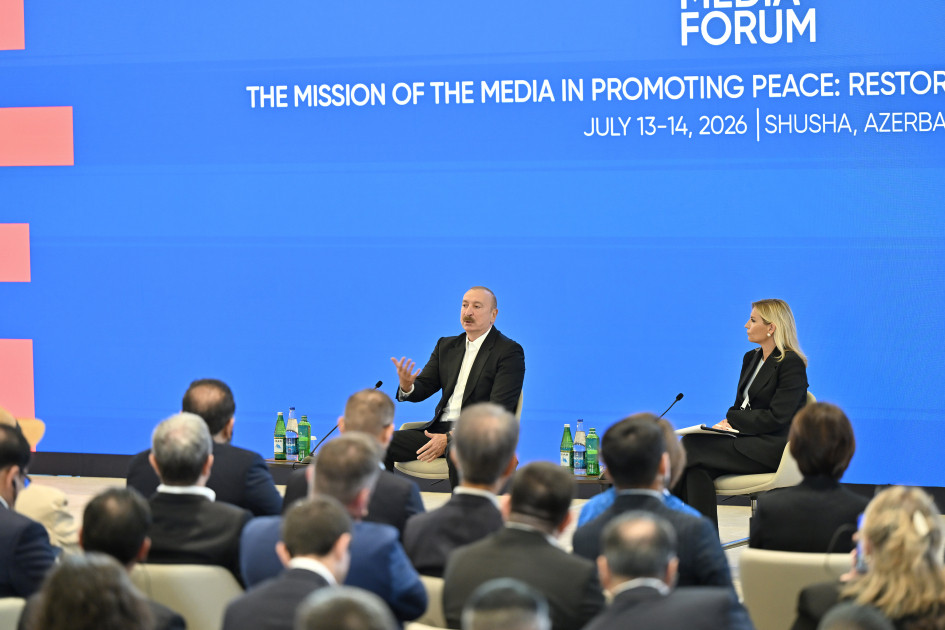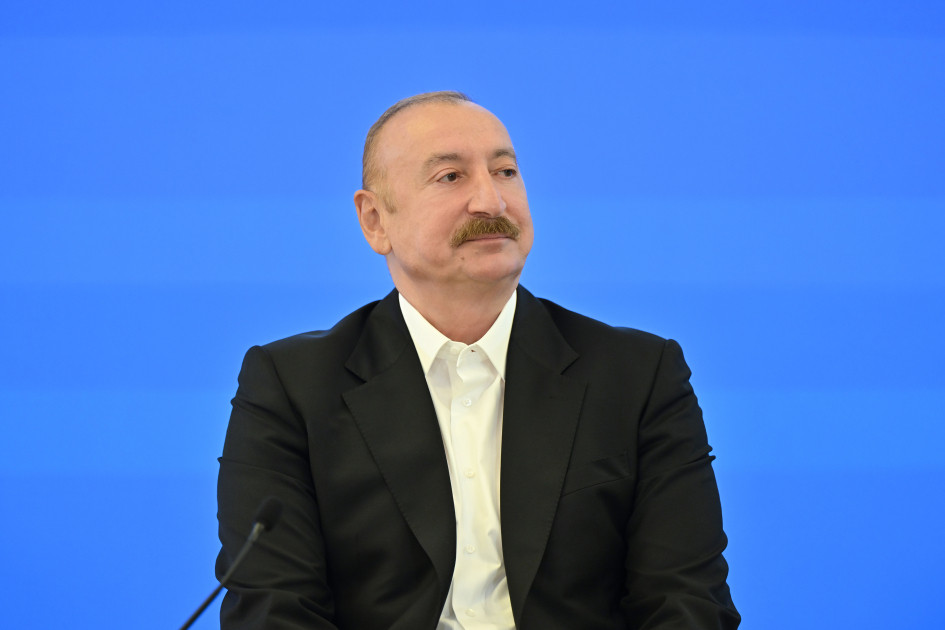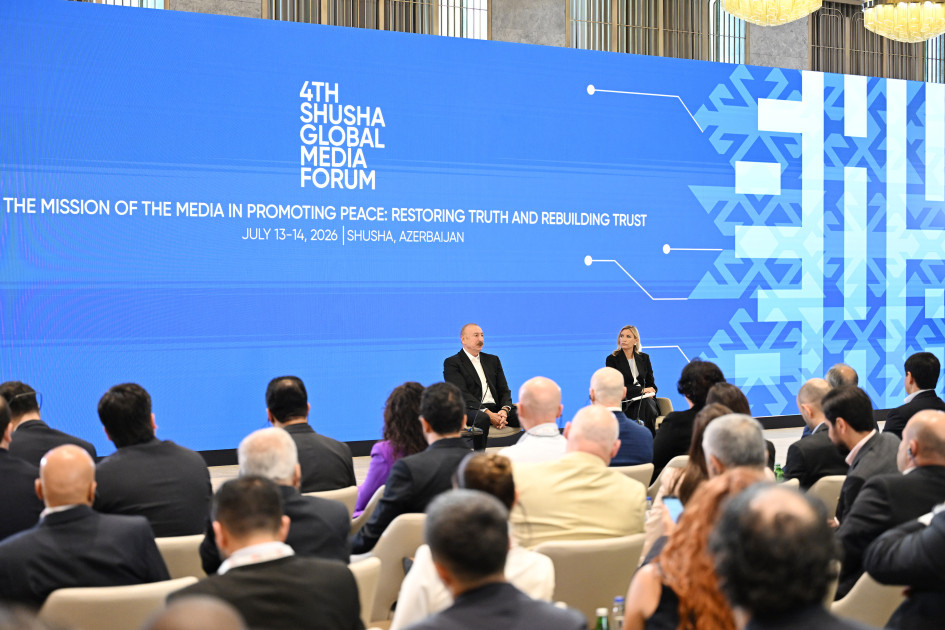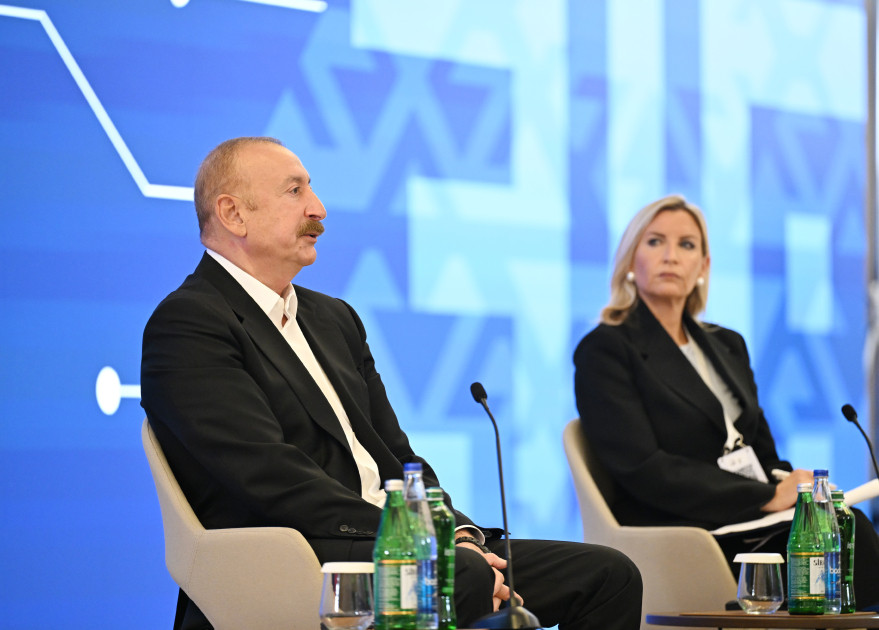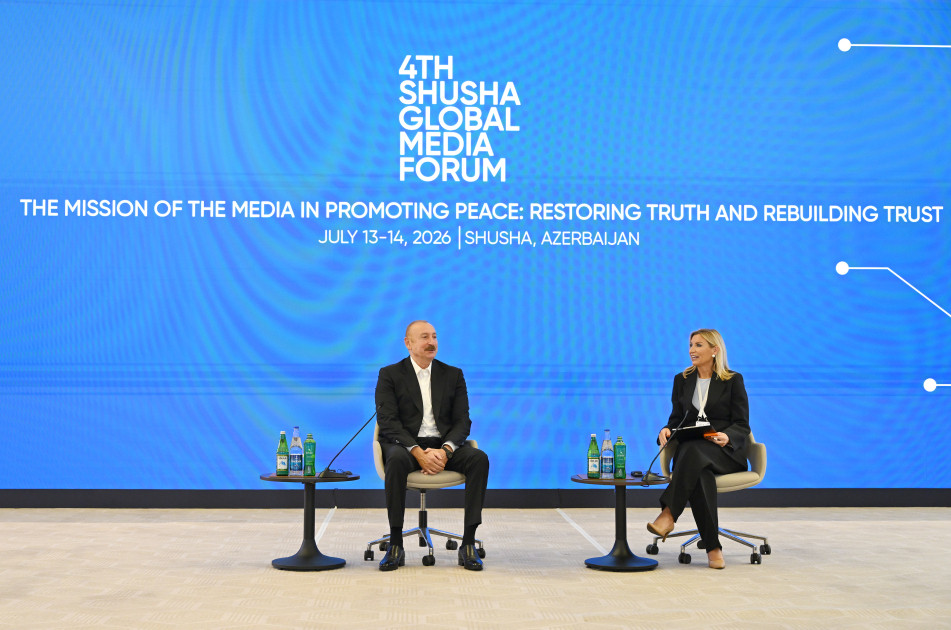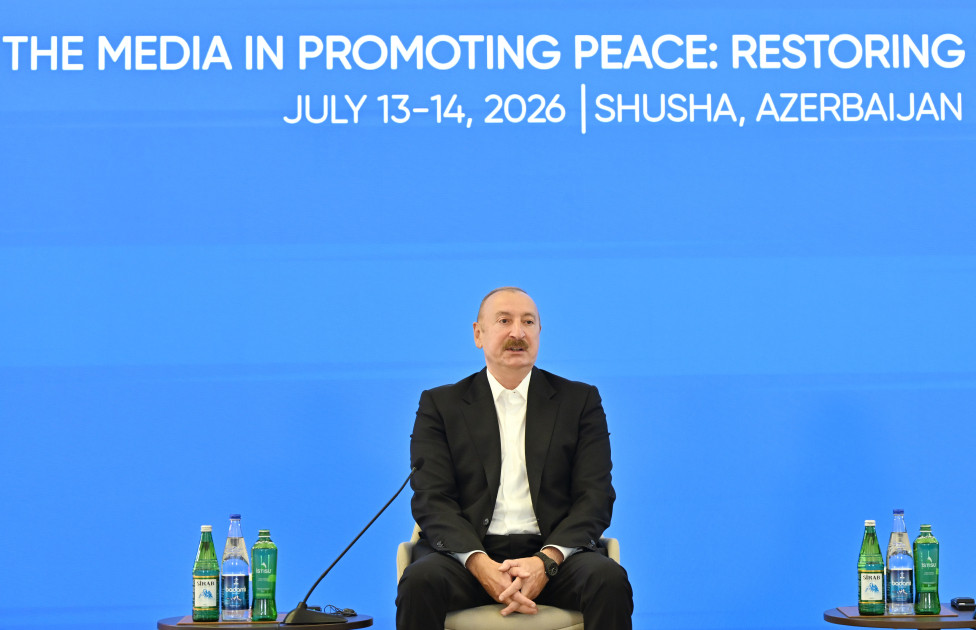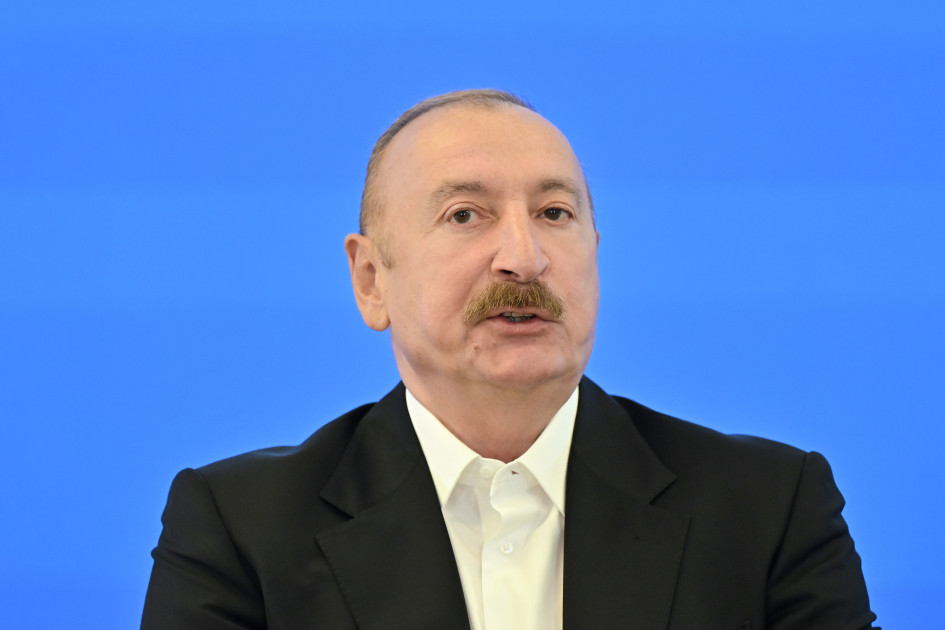
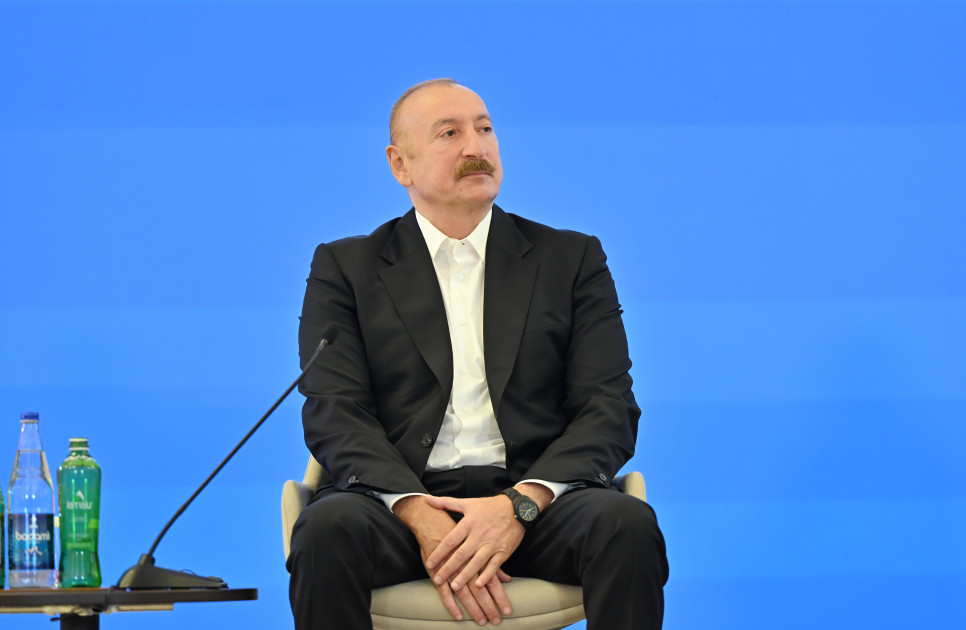
The 4th Shusha Global Media Forum became not just a conversation about media, but a demonstration of Azerbaijan's new role: a country that transforms victory, energy, transportation, diplomacy, and information policy into a unified middle power strategy.
Shusha has long ceased to be just a symbol of return. It has become a political platform where Azerbaijan no longer speaks to the world in the language of justification, but in the language of a state that has changed regional reality through force, law, infrastructure, and diplomacy. This is exactly why the 4th Shusha Global Media Forum, themed "The Mission of Media in Advancing Peace: Restoring Truth and Reviving Trust," was not a media event in the traditional sense. It was a stage where Baku presented its version of a new order to the world: peace is possible not where a conflict is frozen, but where the very architecture of injustice is eliminated.
This was the main political nerve of the speech by the President of Azerbaijan, Ilham Aliyev. He spoke about the media, but in reality, he spoke about power over reality—about who calls war war, occupation occupation, and peace peace, rather than a temporary ceasefire. He spoke about why international law did not work for Azerbaijan for decades, but must now become a universal platform for everyone. He addressed why trust in the media cannot be restored without restoring trust in international politics.
The forum took place at a moment when an arc of instability tightened around Azerbaijan once again. To the south, there is a dangerous confrontation between Iran and the United States. To the north, the ongoing Russian-Ukrainian war continues. To the west, a difficult peace process with Armenia is underway, which will decide not only the issue of borders but also the future transportation map of the South Caucasus. On a global level, there is a struggle by old centers of power to maintain a moral monopoly, even when their own policies increasingly look like double standards.
This is exactly why the national leader's statement that "Azerbaijan is becoming and has even already become a middle power" sounded not like diplomatic self-presentation, but like a political diagnosis. A middle power is not a middle-sized country. It is a state capable of protecting its national interests, imposing its logic on neighbors, being necessary to major players, and at the same time, not dissolving into foreign blocs. President Ilham Aliyev formulated this with utmost clarity: "In my opinion, purely terminologically, the criterion that defines a middle power is the recognition of this country's potential, the recognition of its ability to defend its own national interests."
Shusha Is No Longer a Backdrop: It Is a New Edition of the Political Map
The choice of Shusha for such a forum is a message in itself. In international politics, the venue often speaks louder than the agenda. Shusha is not a neutral conference hall. It is a city around which conflict myths, diplomatic euphemisms, and informational constructs were built for decades. After the liberation of Karabakh, Shusha became a place where Azerbaijan materializes its victory not only through military parades and construction, but also through international communication.
The President of Azerbaijan directly explained the concept behind the forum: "The idea behind holding the event was to create an atmosphere where media representatives from different parts of the world could discuss issues of mutual interest and concern, get acquainted with Karabakh and Shusha, and achieve other goals. I am confident that the guests arriving here see the development and restoration of Karabakh."
This statement is more important than it seems. Azerbaijan no longer asks foreign journalists to take its word for it. It brings them to Karabakh and shows them the restoration as an argument. Roads, airports, power grids, urban infrastructure, and the return of life all become part of the political narrative. In an information war, a tangible object that can be seen is stronger than any press release.
In this sense, Shusha is turning into a laboratory of post-conflict legitimacy. Baku is showing that the territory has not just been returned to sovereignty, but is being integrated into the economic, cultural, and infrastructural body of the state. This fundamentally distinguishes victory from revenge. Revenge ends with a flag. State strategy begins after the flag—with roads, schools, housing, jobs, digital infrastructure, and a continuous international presence.
Therefore, the theme of the forum—restoring truth and reviving trust—has a double meaning in the Azerbaijani context. It is not just about fighting fake news. It is about restoring the political truth that many tried to displace for decades with a convenient diplomatic formula about a "complex conflict." Baku insists that the problem was not complexity, but the unwillingness of many international players to call things by their proper names.
A Middle Power That Has Stopped Asking for Permission
The main significance of President Ilham Aliyev's speech in Shusha is the consolidation of Azerbaijan's new agency. Even twenty years ago, Baku was viewed primarily through three lenses: oil, the conflict with Armenia, and the balance between Russia, Turkey, Iran, and the West. In this scheme, Azerbaijan was assigned the role of a territory caught between foreign interests. Now, Baku itself has become a hub of interests.
This did not happen by accident. Azerbaijan consistently built several pillars: military modernization, energy independence, an alliance with Turkey, transport connectivity, diplomatic flexibility, the rejection of external dictation, and reliance on international law as a tool rather than a rhetorical ornament. The Second Karabakh War was a turning point, but not the sole reason. Victory was possible because the army, the economy, foreign policy partnerships, and internal stability had been built for years prior to it.
Now this logic is being transferred to the peaceful period. President Ilham Aliyev outlined the priorities without ambiguity: "Undoubtedly, today our main task is to ensure sustainable development, the restoration and reconstruction of Karabakh, as well as the completion of projects that will result in the launch of new transport routes." In the same agenda, he mentioned digital transformation and the development of artificial intelligence.
This is no longer the agenda of a country occupied solely with the consequences of war. It is the agenda of a state trying to use the post-conflict moment to accelerate its transition into a new weight class. Karabakh is becoming not just a reconstruction project, but a showcase of governance capacity. Transport routes are becoming not just commercial lines, but geopolitical nerves. Artificial intelligence is not a buzzword, but part of the competition among states for efficiency, security, and a sovereign technological base.
Here, the formula of a "middle power" acquires practical meaning. A middle power does not need to possess nuclear weapons or a permanent seat on the UN Security Council. It needs something else: the ability to create indispensability. Azerbaijan is becoming indispensable in several systems simultaneously—energy, transport, military, diplomacy, and information.
Washington Changed Its Language: From Freeze to Deal
The most politically sharp block of President Ilham Aliyev's speech concerned the United States. The President of Azerbaijan drew a hard line between previous American administrations and the administration of US President Trump. This was not merely praise for the current White House. It was a revision of thirty years of American policy in the South Caucasus.
The President of Azerbaijan recalled Section 907 of the Freedom Support Act, adopted in 1992. For Baku, this amendment was never just a legal technicality, but a symbol of an unfair attitude toward a country that itself faced occupation and the displacement of hundreds of thousands of its citizens. The President of Azerbaijan said: "Section 907 was an unfair step by the US Congress against Azerbaijan. This happened in 1992."
Then came a direct political attack on former US President Joe Biden: "When Biden was a senator, he was one of the initiators of introducing sanctions against Azerbaijan. His vision for the development of the region was that it should be fragmented, mired in conflicts, and dominated by confrontation. Of course, under such conditions, it is easier to achieve goals."
This assessment reflects a broader Azerbaijani grievance against Western policy in the 1990s and 2000s. Baku believes that the conflict with Armenia remained unresolved not because international mechanisms were lacking. UN Security Council resolutions existed. Mediators existed. The OSCE Minsk Group existed. What was lacking was the political will to enforce the restoration of justice. A frozen conflict was convenient; it kept the region in a state of managed dependency.
The President of Azerbaijan formulated this without diplomatic wrapping: "Unfortunately, during the 30-year period of occupation, the main goal of the US administration, along with the then co-chairs of the OSCE Minsk Group, was to freeze this conflict. Azerbaijan's territories were never liberated, despite the existence of relevant UN Security Council resolutions, which they themselves adopted. The goal was to freeze this situation and use it as a pressure mechanism against Azerbaijan and, to a certain extent, against Armenia."
The contrast with Trump was intentionally sharp. "But Mr. Trump has a different character. He strives for peace and views peace as an opportunity. Today, peace has already been established, which creates new opportunities," Ilham Aliyev stated. In another part of his speech, he added: "As he himself has repeatedly noted, President Trump ended eight conflicts in various parts of the world. Such is his character, such is his vision, and such is his policy. As for our issue, he played a very important role here as well. Because when Azerbaijan and Armenia were in the final stage of negotiations, it was President Trump and his team who created the conditions that made peace possible."
For Baku, this is not just a matter of personal affinity for Trump. It is a matter of changing the American role in the region. If the old model was perceived as conflict management, the new one is presented as facilitating a deal. President Ilham Aliyev reported that during a historic meeting at the White House, the US President Trump, together with him and the Prime Minister of Armenia, signed a joint statement, and the foreign ministers of the two countries initialed a peace agreement. This essentially transitions American involvement from a mode of rhetorical mediation to a mode of politically formalizing the new regional reality.
Zangezur Corridor: Infrastructure Changing the Balance
The Zangezur Corridor occupied a special place in the speech. For Azerbaijan, this is not just a road to Nakhchivan. It is a project that links the post-war architecture of the South Caucasus with the Eurasian transportation system. The President of Azerbaijan emphasized that the US leadership realized the importance of the project "because it will connect Azerbaijan with its exclave Nakhchivan."
Several levels of interest converge here simultaneously. The first is national: restoring a direct connection between the main territory of Azerbaijan and Nakhchivan. The second is regional: transforming Armenia from a dead-end country of conflict into a transit country. The third is Eurasian: strengthening the Middle Corridor between Central Asia, the Caspian, the South Caucasus, Turkey, and Europe. The fourth is geopolitical: reducing the monopoly of specific routes passing through unstable or congested directions.
The head of state said: "They worked very effectively, managing to explain to Armenia that this peace is also needed by Armenia itself." This phrase holds the key to Azerbaijani diplomacy in recent years. Baku no longer proves the abstract benefits of peace to Yerevan. It shows the concrete price of rejecting it. Armenia can choose to remain trapped in the logic of historical grievance, dependence, and transport isolation. Alternatively, it can accept the new map, where open communications become a prerequisite for economic survival.
For Azerbaijan, the benefit is obvious: a land connection to Nakhchivan, strengthening the alliance with Turkey, growth in transit revenues, and reinforcing the role of Baku as an operator of corridors. For Armenia, the benefit is less familiar but no less real: an exit from the transport deadlock, integration into regional trade, and reducing dependence on a limited number of external partners. Those who lived for decades off the conflict, closed borders, and fear of peace are the ones who lose.
This is exactly why a struggle of narratives will continue around the Zangezur Corridor. It will be labeled a threat to sovereignty, pressure, a concession, or geopolitical dictation. Yet, the essence is simpler: communications are becoming a test of Armenia's readiness to acknowledge that the era of militarily and diplomatically maintaining the old conflict is over.
Gas as Diplomacy: Why Europe Looks to Baku Again
The energy block of President Ilham Aliyev's speech was equally vital. The President of Azerbaijan stated: "We already supply piped gas to 16 countries. In this regard, we rank first in the world, and these capacities will expand." He added that Baku is negotiating with several European Union members—both regarding the start of supplies and increasing volumes.
This part of the speech demonstrates that Azerbaijan does not view energy solely as an export commodity. Gas has become an element of strategic reputation. Following the Russian invasion of Ukraine, European energy security ceased to be a bookkeeping matter and became part of defense policy. Every new molecule of gas from an alternative source carries a political price. Azerbaijan found itself among the suppliers that Europe cannot ignore.
The president emphasized: "Today, the role of Azerbaijan as a reliable partner, a predictable and alternative supplier, has become more important than ten years ago." This formula is addressed simultaneously to Brussels, Berlin, Vienna, Rome, Sofia, Bucharest, and other European capitals. Europe may criticize Baku in political resolutions, but in winter it needs gas, predictability, and routes. Azerbaijan understands this and is no longer hesitant to speak to Europe in the language of mutual dependence.
"Starting this year, we have already begun exporting gas to Austria and Germany. Strengthening our presence in the European and global markets is part of our overall strategy," the president said. Austria and Germany carry special weight: these are not peripheral markets, but part of the industrial core of Europe. Gaining entry there means a qualitative expansion of Azerbaijan's energy geography.
The Syrian line is even more intriguing. The head of state declared: "We supply gas to markets that we couldn't even think about in previous years, for instance, to Syria. From Syria, we can also supply gas to neighboring countries, where there is also a high demand for gas." This reveals that Baku views energy as a tool to enter new political spaces. After a devastating war, Syria needs electricity, infrastructure, and external partners. Through its link with Turkey, Azerbaijan gains the opportunity to become part of restoring the energy framework of the Eastern Mediterranean and the Middle East.
However, the President of Azerbaijan also outlined a condition: "In our contacts with European partners, we bring to their attention that we need long-term contracts and that it is necessary to expand the existing gas transmission system through joint efforts." This is an important signal. Europe wants flexibility, short-term commitments, and political comfort. The gas producer wants long-term contracts, investments, and guaranteed demand. Without this, expanding production and infrastructure turns into a risk.
Baku is effectively telling Europe: if you want Azerbaijani gas as an element of your security, treat it as a strategic project, not as a temporary substitute.
Europe Without a Monopoly on Morality: PACE, Borrell, and the Colonial Nerve
In the Shusha speech, President Ilham Aliyev sharply separated relations with the European Commission from relations with the Parliamentary Assembly of the Council of Europe. Regarding PACE and the European Parliament, the tone was harsh. The president said: "We do not want to enter into confrontation, especially when it comes to regular attacks by the Parliamentary Assembly of the Council of Europe and the European Parliament against Azerbaijan. I repeat: they are taking unfounded steps against us. You could say it is some kind of obsession on their part."
An even tougher remark was made regarding a potential exit from the Council of Europe: "If Azerbaijan completely leaves the Council of Europe, nobody in the country will even notice. In other words, nothing much will change. Yes, maybe remaining a member of the Council is better, I don't know."
This stance demonstrates a decline in Baku's symbolic dependence on European institutions. In the 1990s, membership in European structures was perceived by many post-Soviet states as a sign of civilizational recognition. Now, Azerbaijan is showing that such legitimacy is no longer an absolute value—especially if institutions, in Baku's view, use human rights and democratic rhetoric as a tool for political pressure.
Regarding the European Commission, the tone was more complex. President Ilham Aliyev acknowledged that under Josep Borrell, relations nearly collapsed: "As for relations with the European Commission and the Parliamentary Assembly of the Council of Europe, there is a very big difference between them. We had different relations with the European Commission. During the period when Mr. Borrell was at the helm of European diplomacy, the relations between the European Commission and Azerbaijan suffered an almost complete collapse."
A personal accusation followed: "It emerged that Josep Borrell maintained relations with certain corrupt individuals, including the former judge of the International Criminal Court, Mr. Ocampo. It turned out that he was funded by a Russian-Armenian oligarch who is currently under house arrest in Armenia." President Ilham Aliyev added: "A major anti-Azerbaijani group operated within the European Commission, and we hope that Mr. Borrell has permanently left politics. Since then, our relations have begun to improve."
Behind this attack lies a deeper conflict over who has the right to speak about human rights, colonialism, sovereignty, and international responsibility. Baku is increasingly responding to the West using its own language—not justifying itself, but bringing counter-accusations. France occupies a special place in this logic.
President Ilham Aliyev touched upon the activities of the Baku Initiative Group and the colonial policy of France. He said: "We believe that human rights are a universal issue. The Baku Initiative Group is perhaps today one of the most effective non-governmental organizations that brought this issue to the global agenda." Then came a topic even more painful for Paris: "For many years, the overseas territories of France have been suffering from its colonial and imperialistic policy. Nuclear tests are even carried out there. In Polynesia, perhaps more than 200 nuclear tests were conducted."
Here, Azerbaijan is doing what Western capitals long considered their exclusive privilege: turning human rights into a tool of the international agenda. Only the object of criticism is no longer Baku, but Paris. This is not just an informational response. It is an attempt to dismantle the moral asymmetry where certain countries are always the judges, and others are always the defendants.
Turkey and Azerbaijan: An Alliance That No Longer Needs Explanation
A dedicated segment of President Ilham Aliyev's speech focused on Turkey. There was no ambiguity here. The President stated: "Turkey and Azerbaijan are two countries whose populations are closer to each other compared to any other countries in the world. Just look at the level of cooperation, political, economic, energy, and transportation ties, as well as people-to-people relations."
Then came the key formula: "We do not know of two other states in the world that are so close to each other, support each other so much, and are such friends with each other. This is an immense wealth of our peoples, and together we are stronger."
The alliance with Turkey remains the primary strategic multiplier for Azerbaijan. It enhances military security, expands transportation capabilities, opens access to the Mediterranean, strengthens Baku's position in the Turkic world, and makes Azerbaijani diplomacy more resilient in relations with Russia, Iran, Europe, and the United States.
At the same time, Baku does not restrict its policy to the Turkish vector. On the contrary, the strength of the alliance with Ankara allows Azerbaijan to develop ties with Central Asia, Georgia, the European Union, Arab nations, Pakistan, China, and other players with greater confidence. This is not dependency, but a foundational support. The difference is fundamental.
Peace Around the Borders: Why Baku Speaks of War Without Panic
The most alarming part of the speech was the assessment of regional security. The head of state spoke about wars in various parts of the world: "We are witnessing wars in different parts of the world. They are occurring not only in the Persian Gulf and the Middle East but also in other regions, which causes disappointment."
He then moved on to Islamic solidarity: "Solidarity within the framework of the Organisation of Islamic Cooperation is a key factor for stability and security. In other words, the higher the level of solidarity and mutual understanding, the fewer difficulties there will be." However, he immediately added: "Unfortunately, today we do not observe much solidarity. On the contrary, we see that tensions are rising, and mutual accusations are being made."
For Azerbaijan, this topic is not abstract. The country is situated between Russia and Iran, next to Turkey, at the crossroads of the Caspian, the South Caucasus, the Black Sea basin, and the Middle East. Under such conditions, any major war near the borders becomes a direct factor of national security rather than a television image.
Regarding the conflict between Iran and the United States, the leader of Azerbaijan stated: "From here, I urge our neighbors to demonstrate responsibility, put an end to this situation as soon as possible, and work toward the normalization of relations. This process must not escalate into a global conflict. This represents a very significant danger." He also expressed hope that the confrontation would be resolved through the mediation of friends from Pakistan.
This position reflects Baku's classic caution: Azerbaijan has no interest in a major war near its southern borders. It would threaten trade, energy, logistics, Caspian security, internal regional stability, and communications. Yet, Baku cannot afford weakness either. Therefore, the calls for peace were followed by a statement on the necessity to strengthen defense: "Unfortunately, today the threats in our region are entirely real. We do not read about this in books—we see it in real life."
The conclusion drawn by President Ilham Aliyev was highly pragmatic: "In a word, we must expand our capabilities, strengthen our defense, uphold our national interests, and reinforce practical cooperation with as many countries as possible." This is the formula of a state that does not view security as a gift. Security must be built, purchased, produced, insured through alliances, and protected in the information domain.
International Law: No Longer a Slogan, But a Weapon of a Victorious State
One of the most important concepts of the speech was returning international law to the center of the Azerbaijani narrative. President Ilham Aliyev said: "We want peace to arrive in the near future both north and south of our borders. However, this peace must be just and based on the norms of international law."
He added: "Peace should not be based solely on someone's claims or the agenda of any single party. International law is a universal platform for establishing peace. During the conflict with Armenia, we always spoke out in defense of international law."
This thought is crucial. After 2020, Azerbaijan could have spoken exclusively in the language of force. Instead, Baku prefers the combination of force and law. Force proved that the status quo could be broken. Law must prove that the new order is not arbitrary. This is an important distinction, particularly for a country that seeks to be not only a victor in a regional war but also a long-term hub for transit, investment, and diplomacy.
In this logic, peace with Armenia should not be a gift to Yerevan, nor should it be a concession by Baku. It must become a legally binding recognition of reality: territorial integrity, the renunciation of claims, the opening of communications, demarcation, and the cessation of the international campaign against Azerbaijan. Without this, peace will remain a pause rather than peace.
Media as a Weapon of Trust
At first glance, the forum was dedicated to the media. However, in Shusha, it became evident that the media can no longer be separated from security. Disinformation, manipulation, selective morality, false human rights campaigns, and the fabrication of aggressor and victim images all function as part of hybrid warfare today. Azerbaijan experienced this throughout the conflict with Armenia and in its aftermath.
The theme of "restoring truth" in Shusha did not sound academic. For Baku, truth is a matter of sovereignty. If external centers can impose a false picture of the conflict on the world, they can weaken a state's right to self-defense. If the media turn into a tool for lobbying networks, public opinion becomes a weapon against international law. If trust in journalism is destroyed, cynicism wins rather than freedom.
Therefore, the Shusha Forum is part of a broader information strategy for Azerbaijan. Baku establishes platforms where journalists, experts, representatives of agencies, and international bodies gather. It shows them Karabakh. It grants direct access to the president. It forms an alternative to the Western-centric system of explaining the region. This is soft power, but with a firm political objective.
The Azerbaijani logic is simple: if the region is described only by those who served the old conflict architecture for decades, the peaceful order will be constantly attacked by old myths. Consequently, new channels of trust must be established.
Five Scenarios After Shusha
The first scenario is the acceleration of the peace process with Armenia. If the initialed agreement transitions into a signed and implemented document, the South Caucasus will gain a chance to exit the mode of permanent war for the first time in decades. In this case, the Zangezur Corridor, the opening of communications, and economic normalization will become the material foundation of peace rather than a mere supplement to it.
The second scenario is the prolonged resistance of old networks. Forces interested in preserving the conflict as political capital will remain in Armenia, Europe, diaspora structures, and parts of the expert community. They will attack corridors, agreements, energy projects, and the very concept of post-conflict normalization. This will not overturn the new reality, but it could slow down its institutional formalization.
The third scenario is a pragmatic restart of relations between Azerbaijan and the European Commission. Gas, transport, Central Asia, the Black Sea, energy security, and digital infrastructure will push Brussels toward a more rational dialogue with Baku. PACE and the European Parliament may continue their ideological pressure, but executive Europe will be forced to count pipes, routes, and megawatts.
The fourth scenario is the enhancement of Azerbaijan's role as a platform between East and West. Ties with Turkey, Central Asia, Pakistan, the Arab world, the United States, and Europe allow Baku to maneuver without entering rigid blocs. This is precisely the behavior of a middle power: not choosing a permanent patron, but building a network of useful partnerships.
The fifth scenario is the growth of threats around the borders. The confrontation between the United States and Iran, the war between Russia and Ukraine, instability in the Middle East, and the struggle over the Caspian and transport routes make the region too critical to remain peaceful automatically. Therefore, Azerbaijan will simultaneously speak of peace and strengthen its defense. For a mature state, this is not a contradiction, but the only method of survival.
The Main Conclusion: Shusha Became the Place Where Azerbaijan Ceased to Be a Topic of Foreign Reports
The 4th Shusha Global Media Forum demonstrated the central point: Azerbaijan no longer wishes to be an object of external interpretation. It is building its own system for explaining the world—through Karabakh, Shusha, international law, energy, transportation, the alliance with Turkey, relations with the United States, criticism of European double standards, and a new role in the Islamic and Turkic spaces.
The speech by President Ilham Aliyev was firm because the balance itself has shifted. A state that has reclaimed its territories, opened new routes, supplies gas to 16 countries, negotiates with Europe, rebuilds Karabakh, promotes the Zangezur Corridor, and participates in resolving regional processes is no longer obligated to speak the language of a petitioner.
Shusha became the ideal venue for this message. A city that was once a symbol of loss is now utilized as a platform to talk about trust. There is a historical irony in this. For decades, the world explained to Azerbaijan why it needed to wait. Now, Azerbaijan explains to the world why waiting is no longer an option.
Truth in international politics rarely triumphs on its own. It must be defended by the military, diplomacy, the economy, infrastructure, and the media. In Shusha, Baku demonstrated that it understands this better than most. Therefore, the forum was not about journalism in a narrow sense. It was about the right of a state to write the first version of its own history—before others attempt to do so once again.