

The Indian military analysis outlet Defence.in has decided to explain to the Armenian audience that after Azerbaijan’s purchase of JF-17 Thunder Block III fighters from Pakistan, Yerevan has supposedly found a brilliant asymmetric answer. Not aircraft against aircraft. Not a modern aviation school. Not its own strike capability. Not a restructuring of command and control. Instead, Indian ground-based air defense. Akash, the prospective Akash-NG, radars, command posts, possibly MRSAM, a short-range tier, attractive diagrams and the familiar Indian advertising gloss.
At first glance, it almost looks like a strategy. At second glance, it is military-political self-therapy.
The idea of layered air defense itself is sound. Every serious army uses it. But the distance between layered air defense and a set of purchased surface-to-air systems is the same as the distance between combat aviation and a plastic model aircraft on an exhibition stand. Layered air defense is not a few circles on a map. It is reconnaissance, radars, passive sensors, secure communications, automated command and control, electronic warfare, decoy positions, mobile groups, close-in protection, missile stockpiles, a repair base and crews operating as a single organism.
In Armenia’s case, what is visible so far is not an organism, but an attempt to stitch new imported organs onto an old body: Indian, Russian, French, Soviet and, in some places, Western. In a presentation, this is called diversification. In real combat, it is a technical hodgepodge.
Pakistan’s contract to supply JF-17 Block III fighters to Azerbaijan was confirmed back in 2024, although neither the number of aircraft nor the financial details were officially disclosed at the time. The version about an expanded procurement of up to 40 aircraft and a price tag of about $4.6 billion has already become part of the regional military discourse. But for Armenia, the main issue is not the accounting of the deal. It is the military meaning of it: Azerbaijan is moving its air component from post-Soviet inertia into a networked, digital, long-range model of air warfare.
Indian authors are trying to sell Yerevan the idea that this challenge can be offset by an Indian “umbrella.” The problem is that an umbrella, however patriotic it may look, performs poorly against a strike fist if it has press releases instead of a frame.
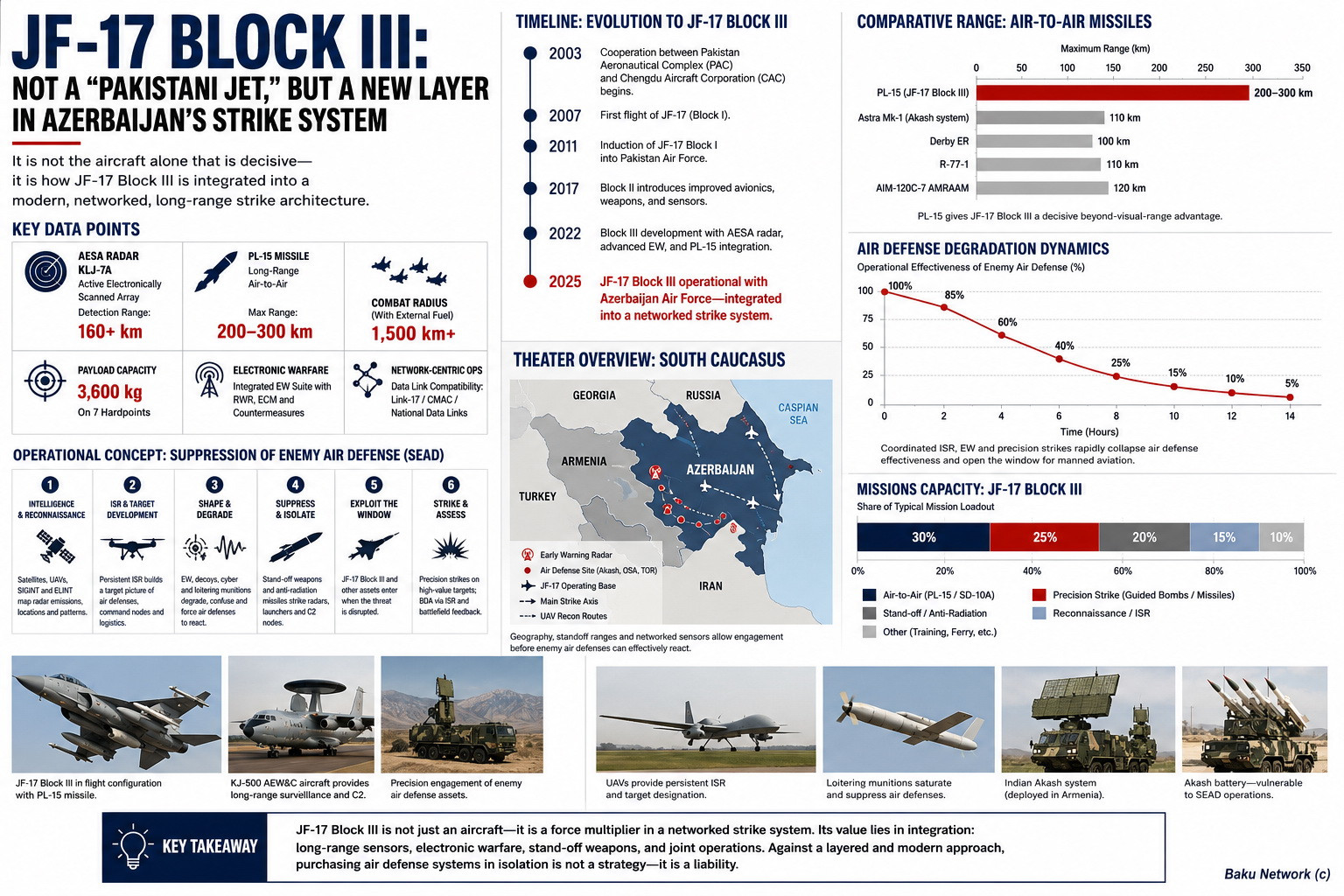
JF-17 Block III: Not a “Pakistani Aircraft,” but a New Layer of Azerbaijan’s Strike System
The main mistake in the Armenian-Indian narrative is to treat the JF-17 Block III as a stand-alone aircraft that is supposed to fly toward an Akash battery and honestly test an Indian missile on itself. That is how wars are fought only in commercials, office fantasies and articles written to reassure Yerevan.
The JF-17 Block III is dangerous not because it is the heaviest, most expensive or most prestigious fighter in the region. It is dangerous because it is an affordable, mass-producible, modern platform for network-centric warfare. An AESA radar, a digital cockpit, helmet-mounted targeting, modern avionics, electronic warfare systems, compatibility with long-range air-to-air missiles and strike weapons are not a museum-grade upgrade. They represent a transition to a different philosophy of airpower.
The JF-17 Block III has been displayed with PL-15 missiles, and that matters fundamentally. Beyond-visual-range air combat, external targeting, AWACS support, group operations and engagement before visual contact were precisely the model that became one of the most unpleasant lessons for India in May 2025.
For Armenian air defense, the danger is not one JF-17. The danger is the combination: reconnaissance UAVs, loitering munitions, decoys, jammers, anti-radiation weapons, long-range missiles, artillery and rocket strikes, ground intelligence, satellite data, signals intelligence and only then aviation.
A modern suppression of enemy air defense operation does not begin with a heroic fighter entering the engagement zone. First, the enemy identifies where the radars are, how often they switch on, which frequencies they use, where the launchers are located, where the transporter-loader vehicles move, where the command posts are, how communication lines are laid out, which positions are real and which are decorative. Then the system is forced to switch on, its channels are overloaded, it is isolated from command and struck with drones, missiles, jamming and precision weapons. Piloted aircraft enter when the “impenetrable shield” already looks like a sieve.
That is why Armenia’s hope in Indian batteries looks less like a strategy and more like an attempt to buy confidence wholesale.
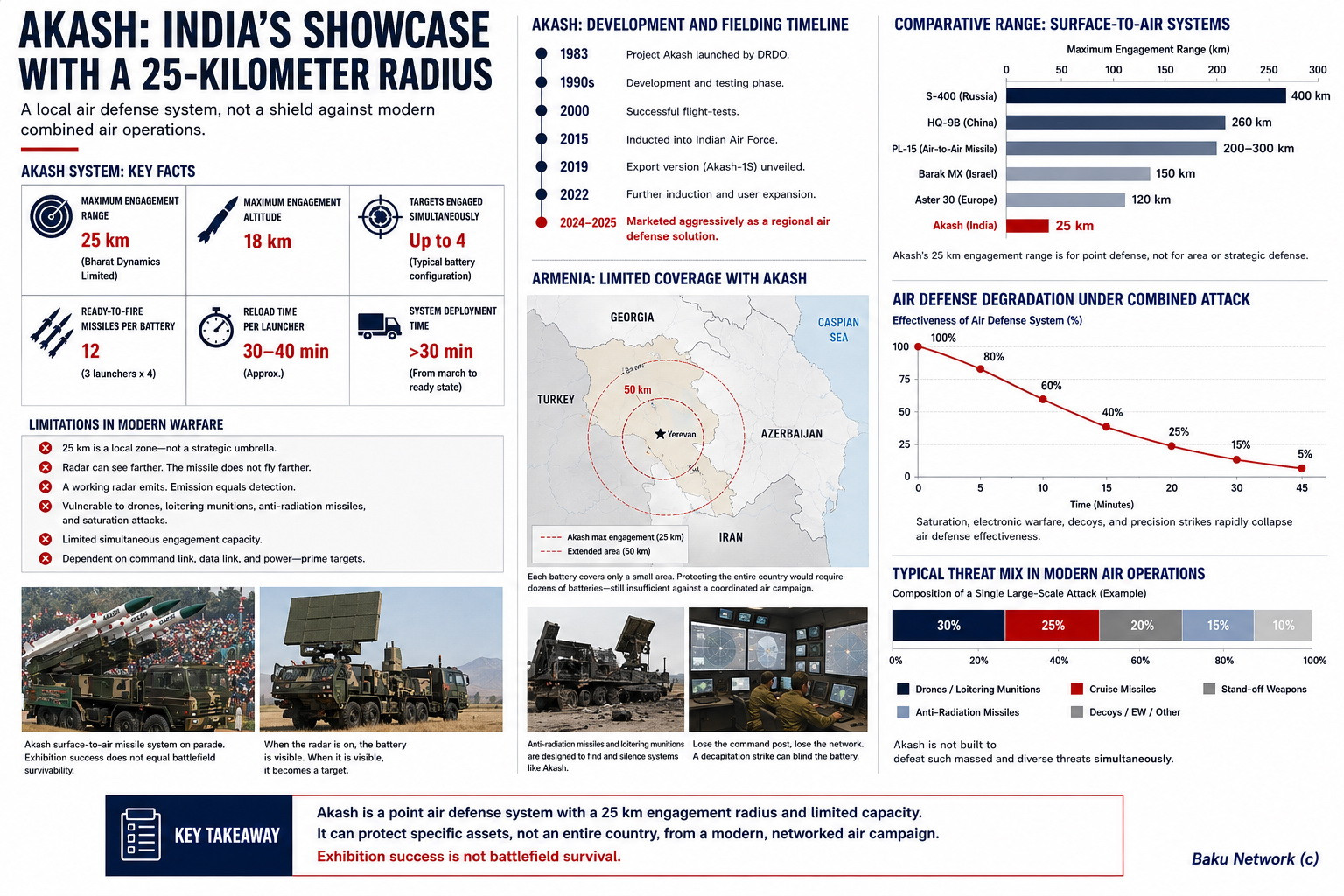
Akash: An Indian Showcase with a 25-Kilometer Radius
In the Indian presentation, Akash looks almost like a universal defense against everything that flies. In reality, it is a point-defense system of short or limited medium range. Bharat Dynamics lists Akash as capable of engaging aerial threats at ranges of up to 25 kilometers and altitudes of up to 18 kilometers. After that dry figure, the advertising orchestra can stop playing.
Twenty-five kilometers is not a strategic dome. It is a local zone. For protecting one facility, yes. For creating psychological discomfort for a pilot, perhaps. For defending all of Armenia against a modern combined air operation, no.
Indian propaganda likes to confuse radar detection range with missile engagement range. A radar may see farther. The missile does not fly that far. Seeing a target and destroying a target are different actions. Between them stand terrain, jamming, reaction time, guidance channels, target maneuvering, false tracks, system saturation and physics, which cannot be canceled by a patriotic poster.
An Akash battery is not a magic box. It is a radar, a command post, launchers, transporter-loader vehicles, communications and support equipment. All of this has to be deployed, protected, camouflaged, supplied, repaired, moved and covered. The radar has to operate. An operating radar emits. An emitting radar is detected. A detected radar becomes a target.
In a war against a technologically prepared adversary, Akash is not asked how impressive it looks at an exhibition. It is asked different questions: how many targets can it track simultaneously; how many can it actually engage; how many missiles are available; how long reloading takes; how quickly the battery can leave its position; how it withstands active jamming; what happens under decoy saturation; who protects it from kamikaze drones; what remains of its combat performance after a strike on the command post.
The answers usually drown in the phrase “indigenous success.”
Success at a test range is when the target flies according to a known scenario. War is when the enemy is not required to respect a DRDO script.
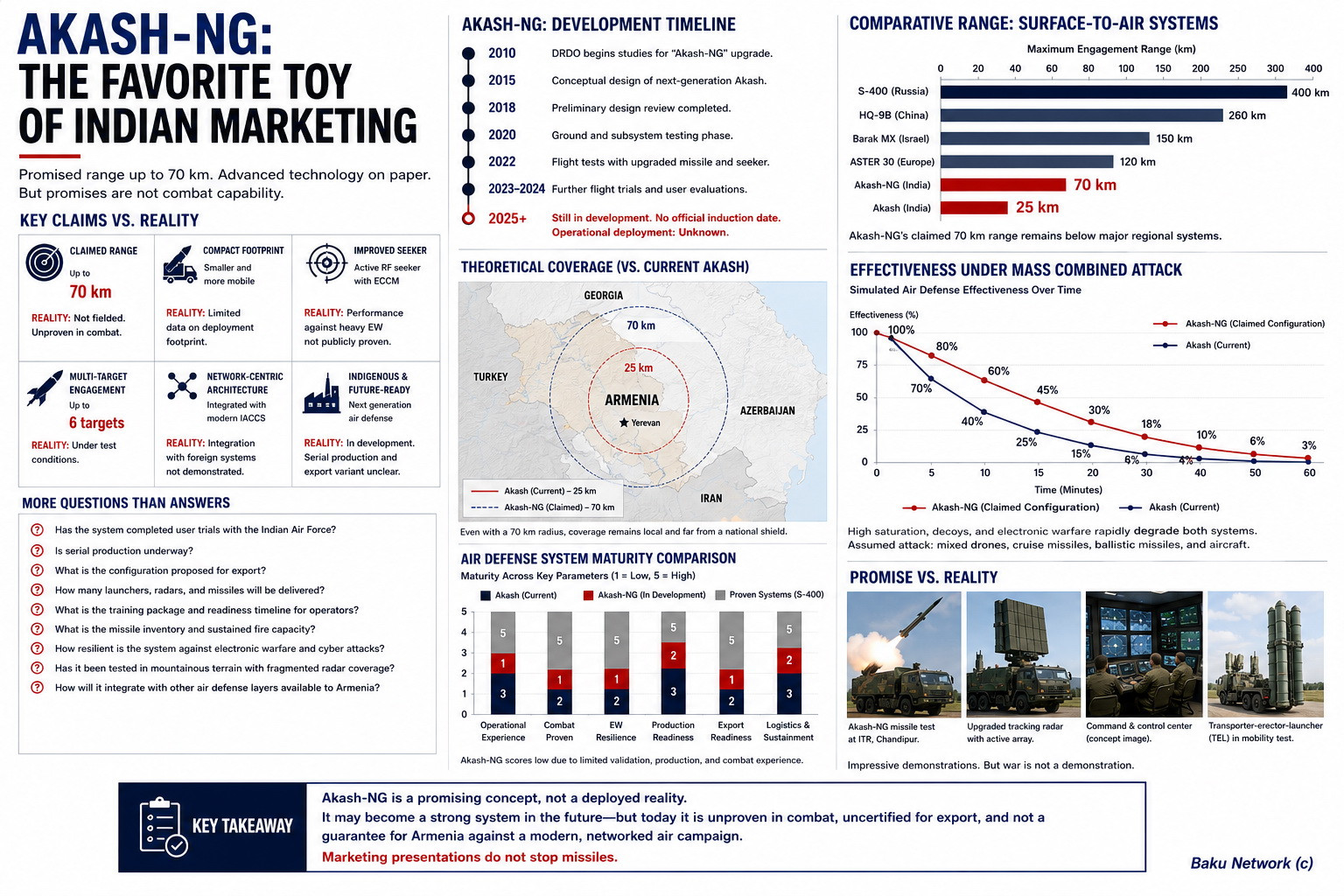
Akash-NG: Indian Marketing’s Favorite Toy
In Indian publications, Akash-NG appears as the saving argument: do not look at the old Akash, there is a new version, with greater range, more compact equipment, a better seeker and stronger mobility.
Yes, Indian materials speak of an Akash-NG range of up to 70 kilometers, a smaller ground footprint and a more modern architecture. DRDO presents NG as a noticeable step forward compared with the baseline system.
But a tested system is not a deployed system. A prospective missile is not an Armenian combat network. Declared range is not proven resilience against electronic warfare. A test launch is not the repulsion of a massed attack. A presentation is not war.
The Indian defense press likes to leap over the most uncomfortable stages: user trials, serial production, export configuration, delivery, crew training, missile stocks, repair infrastructure, integration with other systems, cyber resilience, testing under jamming conditions and operation in a mountainous country with a fragmented radar field.
For Armenia, Akash-NG still looks less like a real guarantee and more like an advertising lure. Convenient for India’s defense industry. Pleasant for Armenian politicians. Extremely doubtful as an answer to Azerbaijan’s system of aviation, UAVs, missiles and electronic warfare.
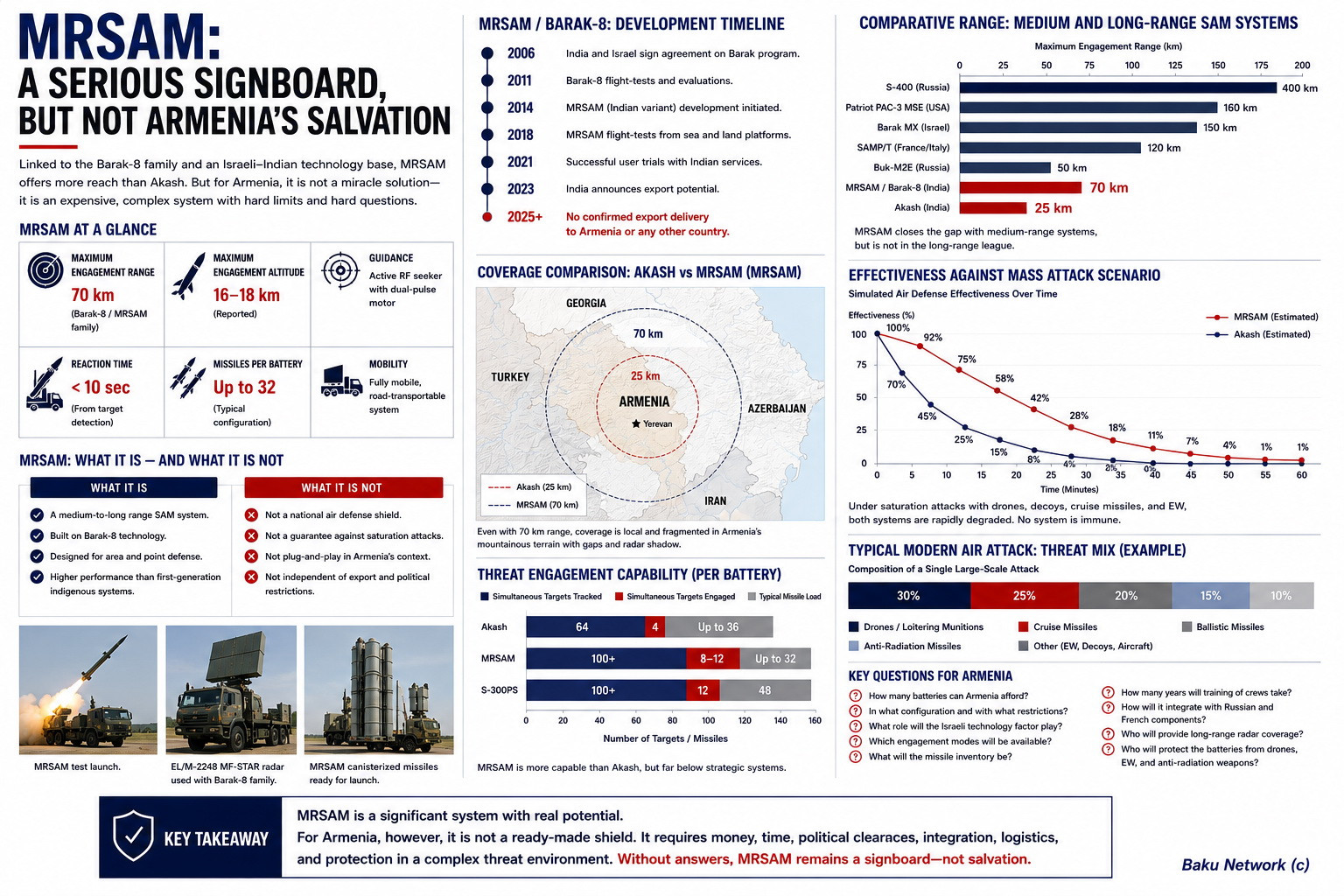
MRSAM: A Serious Signboard, but Not Armenia’s Salvation
MRSAM is a more serious story, because it is connected to the Barak-8 family and the Israeli-Indian technological base. Indian materials cite a range of roughly 70 kilometers for Barak-8 and MRSAM. That is no longer Akash with its 25 kilometers.
But even MRSAM does not become a miracle for Armenia. How many batteries can Yerevan buy? In what configuration? With what restrictions? What role will the Israeli technological factor play? Which modes will be available? What will the missile stockpile look like? How many years will crew training take? How will the system be integrated with Russian and French components? Who will provide long-range radar coverage? Who will protect the batteries themselves from drones, electronic warfare and anti-radiation weapons?
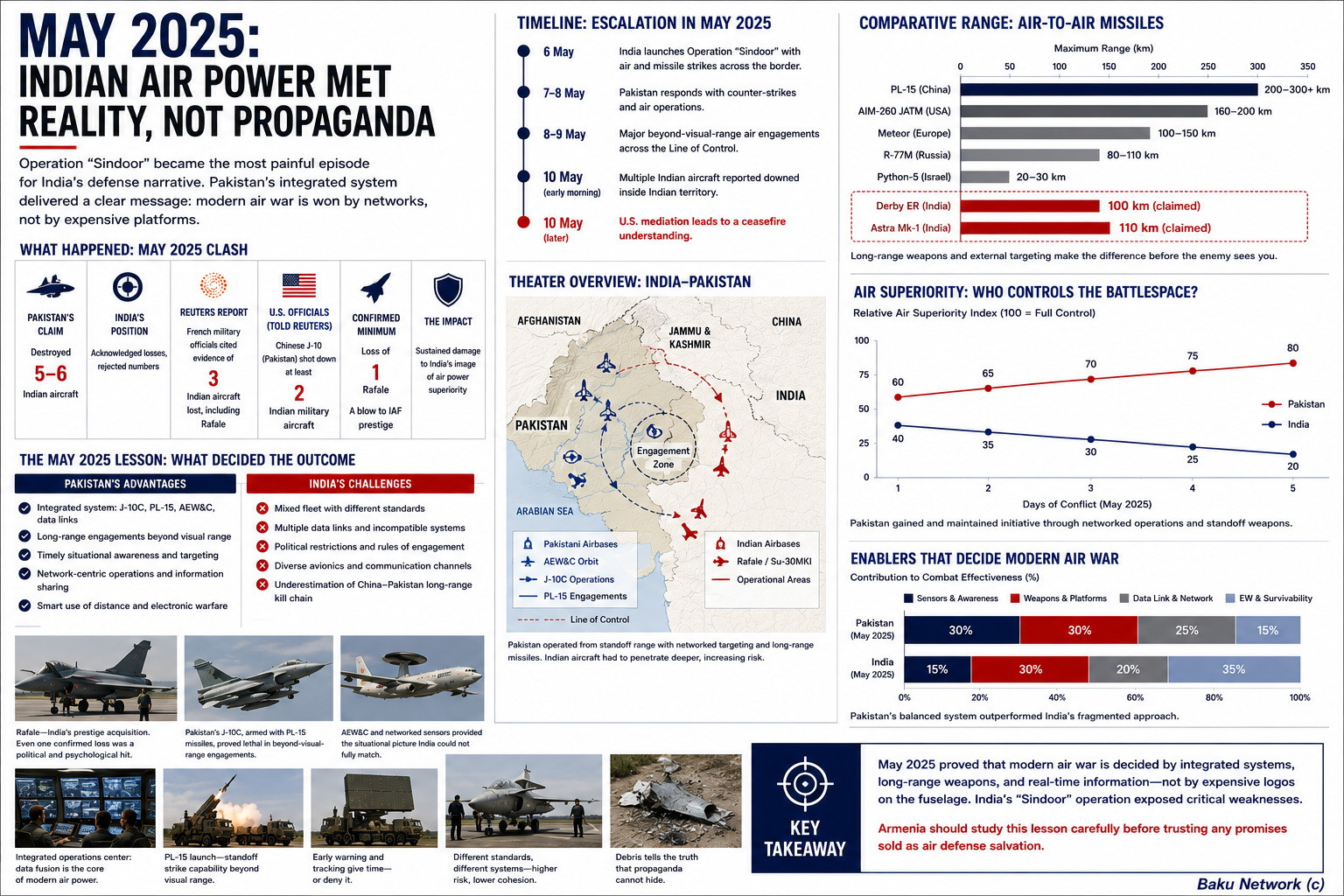
May 2025: Indian Aviation Faced Reality, Not Propaganda
The most uncomfortable episode for India’s defense myth was the May 2025 clash with Pakistan, which India calls Operation Sindoor. There is no need here to repeat the street-market formula that Pakistan shot down “all Indian aircraft.” That is not analysis. The accurate picture is harsher precisely because it does not need exaggeration.
Pakistan claimed the destruction of five, then six Indian aircraft. India acknowledged losses but rejected the Pakistani figure. Reuters reported that French military leadership spoke of evidence of the loss of three Indian aircraft, including a Rafale. Even confirmation of the loss of a single Rafale was a blow to the prestige of the Indian Air Force, because Rafale was a symbol of expensive modernization and a politically significant procurement.
Reuters also reported, citing U.S. officials, that a Chinese J-10 in service with Pakistan shot down at least two Indian military aircraft. That was a blow to India’s confidence that an expensive Western platform by itself determines the outcome of an air battle.
The meaning of the May lesson is simple: modern air warfare is not won by the most pompous aircraft, but by the better assembled system. Judging by open-source data, Pakistan operated through a combination of J-10C fighters, long-range PL-15 missiles, AWACS aircraft, tactical information exchange and a competent choice of combat distance. India ran into the problem of a mixed fleet, heterogeneous standards, political limitations, different avionics, different data links and an underestimation of the Chinese-Pakistani long-range air combat architecture.
And after that, the Indian press explains to Armenia that Indian air-defense technology will become the answer to Azerbaijani aviation. Bold. Almost as bold as building a pyramid of soldiers on motorcycles and presenting it as proof of combat readiness.
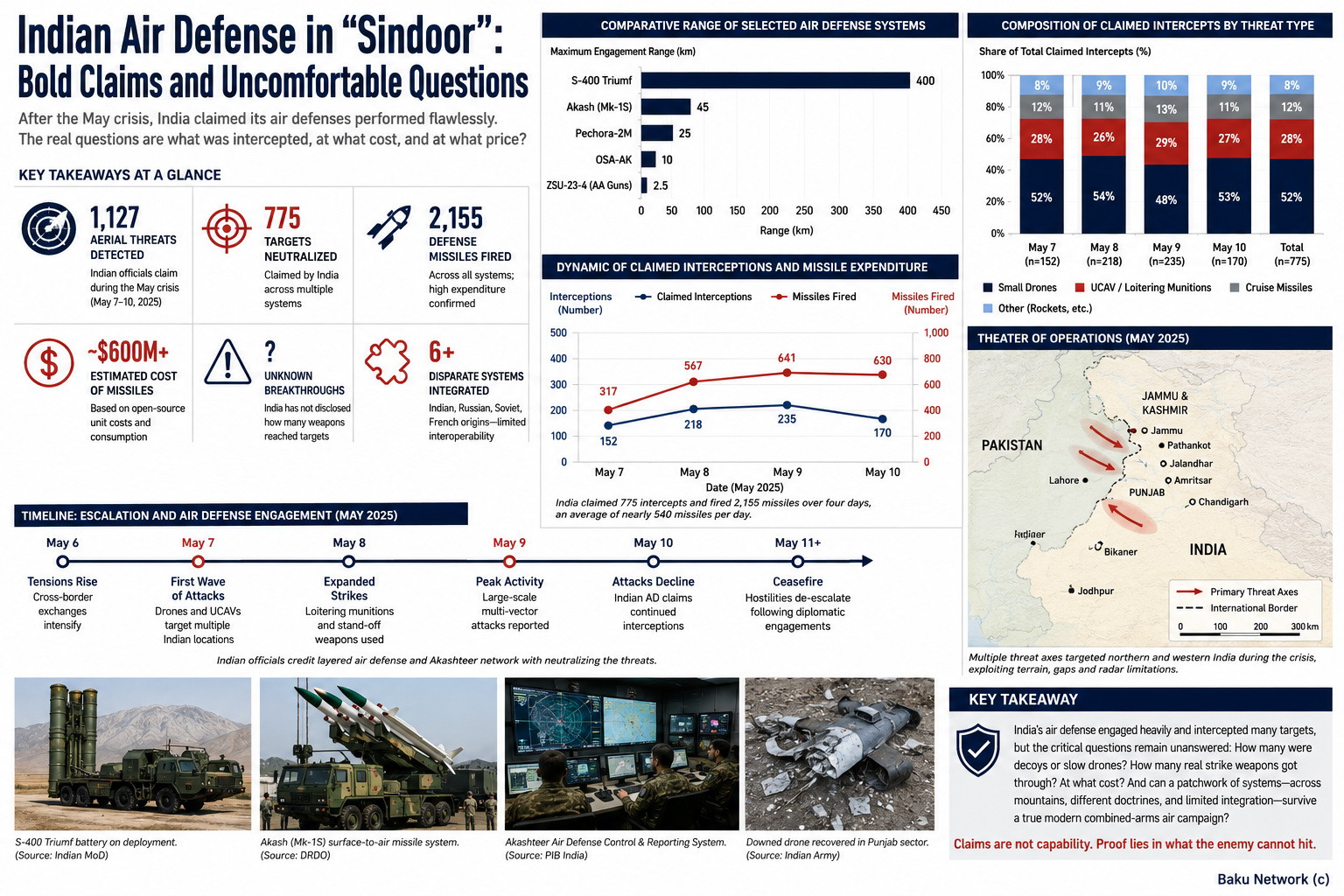
Indian Air Defense in “Sindoor”: Pretty Claims and Uncomfortable Questions
After the May crisis, Indian official sources claimed that their air defenses had successfully operated against Pakistani drones, UCAVs and other attack assets. Akash, S-400, Pechora, OSA-AK, anti-aircraft artillery and the automated Akashteer system were mentioned. India’s government press bureau wrote that Akashteer helped neutralize incoming threats.
But the professional question is not whether some targets were shot down. Of course they were. The question is which ones.
How many were cheap decoys? How many were slow drones? How many were real strike platforms? Which targets reached the attack areas? What was the missile expenditure? What portion of the result belongs to Akash, and what portion to S-400, Pechora, OSA-AK, artillery, electronic warfare and the overall command system? Was Akash subjected to full-scale suppression by anti-radiation missiles and powerful jamming? Or was this mainly a matter of countering drones and isolated attack assets?
Indian propaganda likes to turn the phrase “we shot down drones” into “our system can withstand modern air warfare.” There is an abyss between those two statements.
Shooting down a drone is one thing. Withstanding a combined operation in which decoys, loitering munitions and missiles arrive simultaneously, jamming is active, communication nodes are destroyed and radars are forced to switch on and expose themselves is something else entirely.
That is exactly what awaits any limited Armenian air-defense system if it tries to impersonate a strategic shield.
Armenian Mountains: Not a Fortress, but a Radar Trap
Armenia often comforts itself with its terrain. The mountains, it says, help with defense. Partly, yes. They can conceal positions, complicate low-altitude routes, create ambush areas and reduce a pilot’s reaction time.
But mountains also create radar shadows. They break up the field of view. They limit the work of ground-based radars. They complicate communications. They make supply routes predictable. They narrow the choice of sites for large radars. They force heavy equipment to move along limited roads. They allow drones and cruise missiles to use folds in the terrain.
Such geography requires dozens of sensors, passive stations, relays, mobile posts, protected command centers, engineered positions, decoy batteries and constant redeployment. A few Indian batteries will not provide that.
In the mountains, Akash faces the same physics as any other system. A missile does not cancel the radar horizon. A radar does not see through a ridge. A command post does not become invulnerable just because it has been called part of layered defense.
Indian, Russian, French: Armenian Air Defense as a Technical Hodgepodge
Armenia is trying to hold on to its Soviet and Russian legacy, purchase Indian systems, receive French radars and air-defense assets, build its own solutions and connect Western communication channels all at the same time. In a political presentation, this sounds like a multi-vector approach. In combat, it may look like a collection of incompatible blocks.
Different data-exchange protocols. Different identification systems. Different communication standards. Different target-designation formats. Different maintenance requirements. Different training schools. Different suppliers. Different software restrictions. Different rules for access to technical documentation.
To turn all of this into a unified air-defense system, years of systematic work are needed: money, programmers, testing, cyber protection, exercises, a single command center and iron discipline. Without that, delays appear in transmitting coordinates, targets are duplicated, the risk of friendly fire increases, time is lost, data fails to match and dependence on foreign technical support grows.
A French radar, an Indian missile, a Russian habit of command and Soviet infrastructure do not become the twenty-first century through a single press release.
Karabakh Has Already Shown What Happens to Fragmented Air Defense
Armenian air defense was already tested in the 2020 war and in the clashes that followed. Azerbaijan demonstrated how drones, loitering munitions, reconnaissance, artillery and precision strikes work in a single operational loop. Armenian crews lost equipment not only because some systems were obsolete. They lost it because the system was predictable, poorly protected, insufficiently mobile and weakly integrated.
Positions were exposed. Radars stayed active for too long. Camouflage was weak. The close protection of batteries could not withstand the UAV threat. There was effectively no air component capable of suppressing the carriers of those threats. Retaliatory strikes against the sources of firepower were limited.
Now Yerevan wants to replace part of the hardware with Indian systems and call it a new strategy. But if the old organization remains unchanged, the new system simply dies at a higher price.
A modern missile embedded in an old model of thinking does not save an army. It only increases the cost of future losses.
The Economics of Illusion: Air Defense Is Not Cheap if It Is Built Properly
Another convenient myth is that air defense is cheaper than aviation. Yes, one battery is cheaper than an aviation regiment. But a full-scale layered air-defense system is not one battery.
Armenia would need dozens of radars, several types of surface-to-air missile systems, hundreds and thousands of missiles, close-in cover, passive stations, protected communications, mobile command posts, decoy positions, repair centers, spare components, regular live-fire training, software updates, electronic-warfare assets, counter-drone systems, reconnaissance UAVs and a missile-attack warning system.
That means billions of dollars. More importantly, it still remains a defensive instrument. It does not move the threat onto the enemy’s territory. It does not destroy airfields. It does not suppress depots. It does not break logistics. It does not impose the tempo on the enemy. It does not provide the strategic initiative.
Air defense without strong aviation often turns into an expensive fortress that the enemy studies, exhausts, blinds and opens layer by layer.
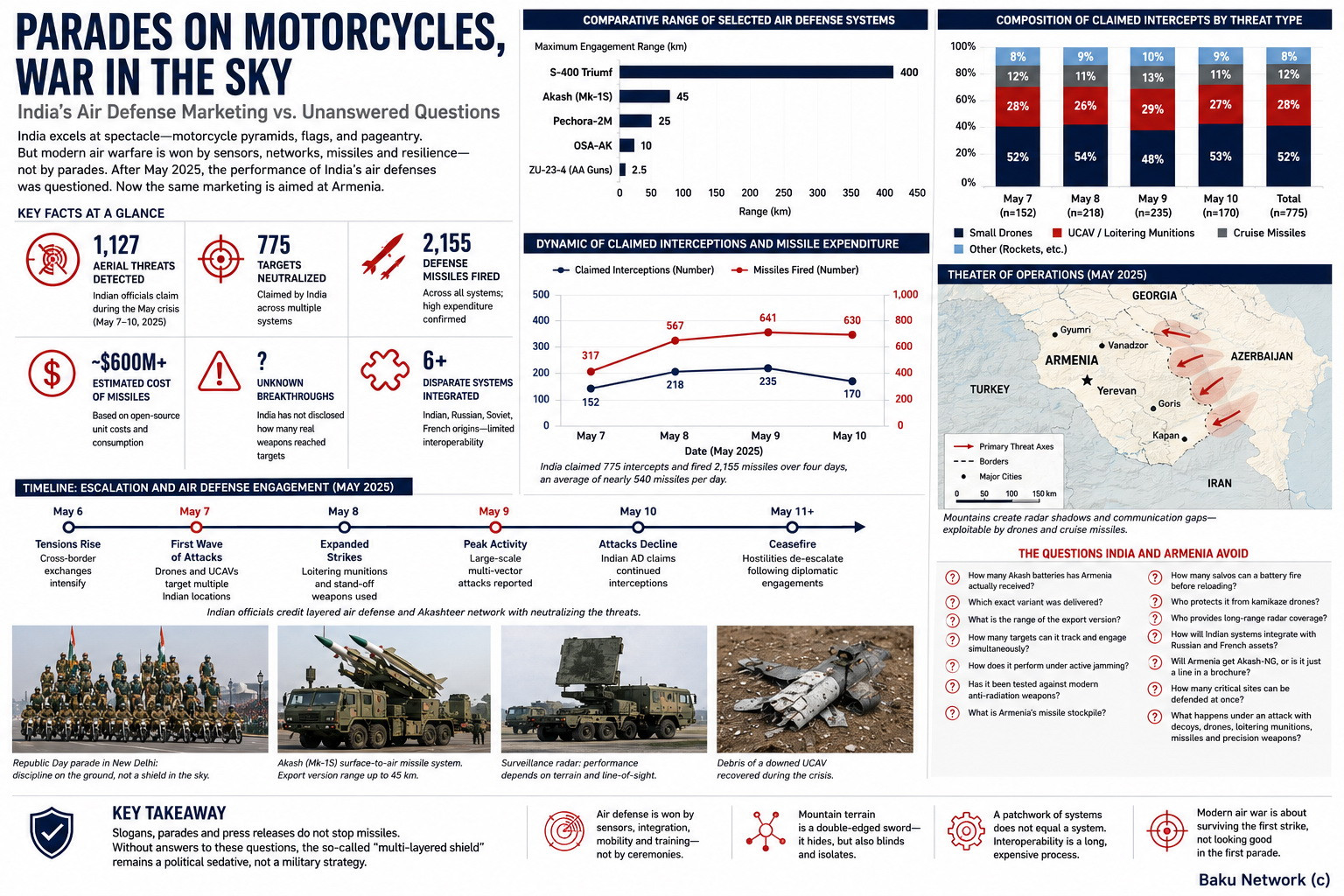
Motorcycle Parades and Air War
The Indian army knows how to produce an impressive picture. Multi-tier formations on motorcycles, flags, acrobatics, synchronized movements, scenes that look like a mass sequence from an Indian film. For the viewer, it is bright. For television, it is convenient. For domestic propaganda, it is ideal.
But not a single motorcycle pyramid answers the question of radar resistance to jamming. Not a single flag at a parade increases missile range. Not a single acrobatic act replaces a protected command network. Not a single beautiful column proves that the system can withstand the first strike of a technologically prepared adversary.
India’s problem is not that it has no army. The problem is that its defense propaganda too often replaces analysis with spectacle. After May 2025, that spectacle cracked. And now the same defense marketing is trying to sell Armenia the illusion that the Indian “umbrella” can balance Azerbaijan’s aviation-drone system.
The main questions that Indian and Armenian authors avoid are extremely simple.
How many Akash batteries has Armenia actually received? Which exact modification was delivered? What is the range of the export version? How many targets can the system simultaneously track and engage? How does it operate under active jamming? Has it been tested against modern anti-radiation weapons? What missile stockpile does Armenia have? How many salvos can a battery fire before reloading? Who protects it from kamikaze drones? Who provides long-range radar coverage? How will Indian systems be connected with Russian and French systems? Will Armenia receive Akash-NG, or will it remain a pretty line in an Indian advertising brochure? How many facilities can be protected at the same time? What happens when dozens of decoys, drones, loitering munitions and precision weapons strike at once?
As long as there are no answers, talk of a “multi-layered shield” remains not a military strategy, but a political sedative.
An Indian Catalog Is Not the Sky, and Armenian Hope Is Not a Strategy
Armenia may buy Indian systems, display them at parades, draw range circles on maps and convince itself that it has found an asymmetric answer to Azerbaijan. But reality is harsher.
Akash is a local point-defense system, not a strategic dome. Akash-NG still looks more like an Indian marketing argument than a proven Armenian combat capability. MRSAM is theoretically more dangerous, but without a network, sufficient quantity, protection, missile stocks and unified command, it too risks remaining an expensive island of defense.
Azerbaijan is forming a system of offensive capabilities: aviation, UAVs, missiles, reconnaissance, electronic warfare, precision weapons and networked command. In response, Armenia risks buying a set of defensive islands, between which radar shadows, organizational failures and vulnerable communication channels will remain.
An Indian surface-to-air missile system can be a weapon. But an Indian advertising catalog is not layered air defense. Parade theatrics are not combat effectiveness. The attempt to compensate for an aviation gap with an imported “umbrella” full of technological holes does not change the main point: in the new air reality of the South Caucasus, Armenia is once again trying to treat a strategic disease with a cosmetic purchase.