

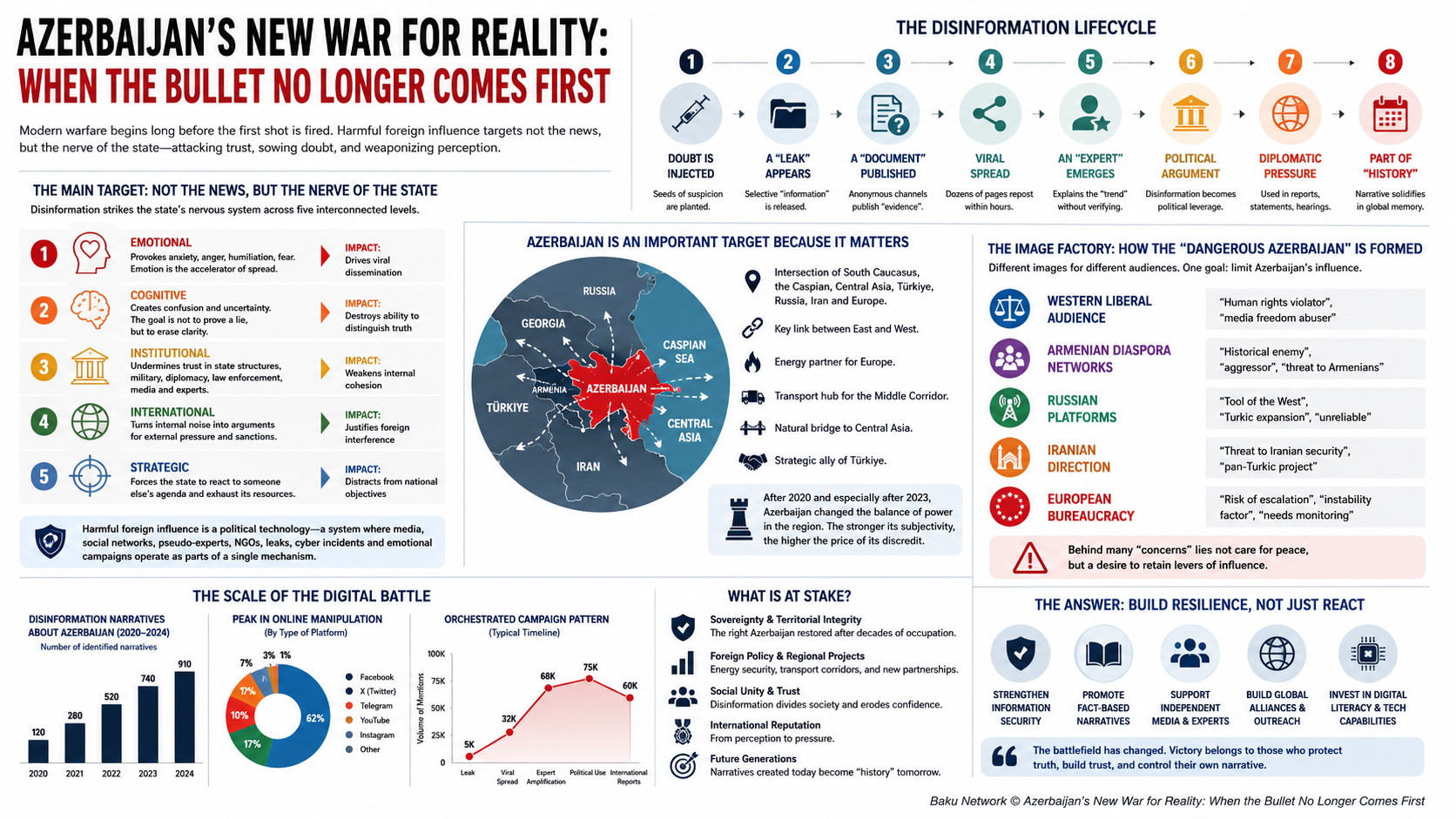
Modern warfare possesses an unpleasant characteristic: it begins long before the first shot is fired. Sometimes, it does not require a shot at all. First, doubt is injected. Then, a "leak" appears. Next, an anonymous channel publishes a "document." Within a few hours, dozens of social media pages repost it. Then an "expert" emerges, who no longer verifies the fact but instead explains the "trend." The next day, the disinformation becomes a political argument, a week later - part of diplomatic pressure, a month later - an element of an international report, and a year later - nearly history.
This is how the new infrastructure of harmful foreign influence operates. It looks nothing like the classic twentieth-century propaganda with a loudspeaker, a newspaper editorial, and a crude slogan. It is subtler, more technological, and more flexible. Its task is not always to convince society of one big lie. More often, the goal is different: to destroy trust in facts as such, to make the state vulnerable to internal noise, and to turn public discussion into a swampy terrain where it is no longer possible to distinguish a document from a fake, journalism from an influence operation, criticism from a managed attack, or civic activism from an external political assignment.
For Azerbaijan, this topic has long transcended the boundaries of media hygiene. This is not about someone publishing incorrect news, confusing a date, or mistranslating a statement. This is about a systemic struggle for the perception of Azerbaijan - inside the country, in the region, in Western capitals, in international organizations, in expert communities, and on digital platforms, where not only public opinion but also political pressure is shaped today.
Following the restoration of its territorial integrity, Azerbaijan entered an entirely new historical cycle. Baku ceased to be a state forced to spend decades explaining the obvious to the world: occupation, displacement, destroyed cities, and the right to sovereignty. Azerbaijan has transitioned into a phase of regional project design - communications, transport corridors, energy, Central Asia, the Caspian, the Middle East Corridor, new security formats, and diplomatic subjectivity. It was precisely at this moment that information attacks became more sophisticated rather than weaker. This is natural. The stronger the subjectivity of a state, the higher the price of its discredit.
The Main Target Is Not the News, but the Nerve of the State
Fake news is often mistakenly perceived as informational garbage. In reality, a high-quality disinformation campaign is structured differently. It strikes not at an individual fact, but at the nervous system of the state.
It operates on several levels.
The first is emotional. It aims to provoke anxiety, anger, a sense of humiliation, injustice, or fear. Emotion is needed as an accelerator for dissemination. A person shares what outrages them much faster.
The second is cognitive. It aims to introduce confusion. It is not necessary to prove a lie. It is sufficient to ensure that the audience ceases to understand whom to believe.
The third is institutional. It aims to undermine trust in state structures, the military, diplomacy, law enforcement agencies, media, and the expert community.
The fourth is international. It aims to transform internal noise into an argument for external pressure: "the country is in crisis," "society is split," "the authorities are hiding something," "Azerbaijan is acting aggressively," "regional stability is under threat."
The fifth is strategic. It aims to force the state to react to someone else's agenda, waste energy on refuting imposed accusations, and defend itself instead of advancing its own foreign policy architecture.
In this sense, harmful foreign influence is not a collection of publications. It is a political technology in which media, social networks, pseudo-experts, non-governmental organizations, diplomatic signals, leaks, cyber incidents, and emotional campaigns operate as parts of a single mechanism.
Azerbaijan as a Target After Victory
Azerbaijan's vulnerability to such operations is explained not by weakness, but by significance. Countries upon which nothing depends rarely become the object of complex information campaigns. Resources, networks, narratives, and political capital are not wasted on them.
Azerbaijan is important for several reasons at once.
It is located at the intersection of the South Caucasus, the Caspian, Central Asia, Türkiye, Russia, Iran, and Europe. It controls a key geographical link between East and West. It is an energy partner for Europe, a transport hub for the Middle Corridor, a natural bridge to Central Asia, and a strategic ally of Türkiye. After 2020, and especially after the full restoration of sovereignty in 2023, Azerbaijan drastically altered the balance of power in the region.
This is precisely why the struggle surrounding its image has become so fierce. It is not always convenient for external players to argue with reality in the language of law: internationally recognized borders, sovereignty, territorial integrity, fulfillment of resolutions, and the return of control over its own territories. It is much more convenient to shift the conflict into the realm of emotions, moralizing, and managed narratives.
Thus, a typical technology is born: if it is impossible to challenge the sovereign right of a state, its reputation must be attacked. If it is impossible to return to the old status quo on the ground, a new status quo must be created in international perception. If it is impossible to stop Azerbaijan by military means, attempts can be made to restrict it diplomatically, informationally, legally, and psychologically.
The Image Factory: How the "Dangerous Azerbaijan" Is Formed
Harmful foreign influence rarely speaks directly. It operates through images. Attempts are made to present Azerbaijan alternately as a "threat to the region," an "energy blackmailer," an "undemocratic exception," an "overly independent player," or a "problem for European politics." Each image has its own audience.
For the Western liberal segment, the language of human rights and media freedoms is utilized. For the Armenian diaspora, the language of historical trauma and revenge is used. For some Russian platforms, the language of suspicion toward the Turkic factor and Western influence is deployed. For the Iranian direction, it is the fear of Azerbaijani identity, the Turkish-Azerbaijani alliance, and a potential change in the regional balance. For the European bureaucracy, it is a conversation about "risks of escalation," where the victim of a decades-long occupation and the party that restored its sovereignty are artificially placed on the same plane as the forces that maintained an illegal status quo for decades.
Such an approach is dangerous because it masks political interest as universal morality. In reality, behind many "concerns" lies not a care for peace, but a desire to retain levers of influence. The old Karabakh issue was a convenient tool for pressuring Baku. When this tool disappeared, the struggle for new mechanisms began: the constitutional topic in Armenia, the issue of communications, monitoring missions, information campaigns, accusations, reports, network attacks, and artificial scandals.
The problem is not with criticism itself. Criticism is necessary for any state. The problem begins where criticism becomes a technology of external management, where facts are selected not for analysis, but for a pre-written indictment.
Disinformation as a Continuation of Diplomacy by Other Means
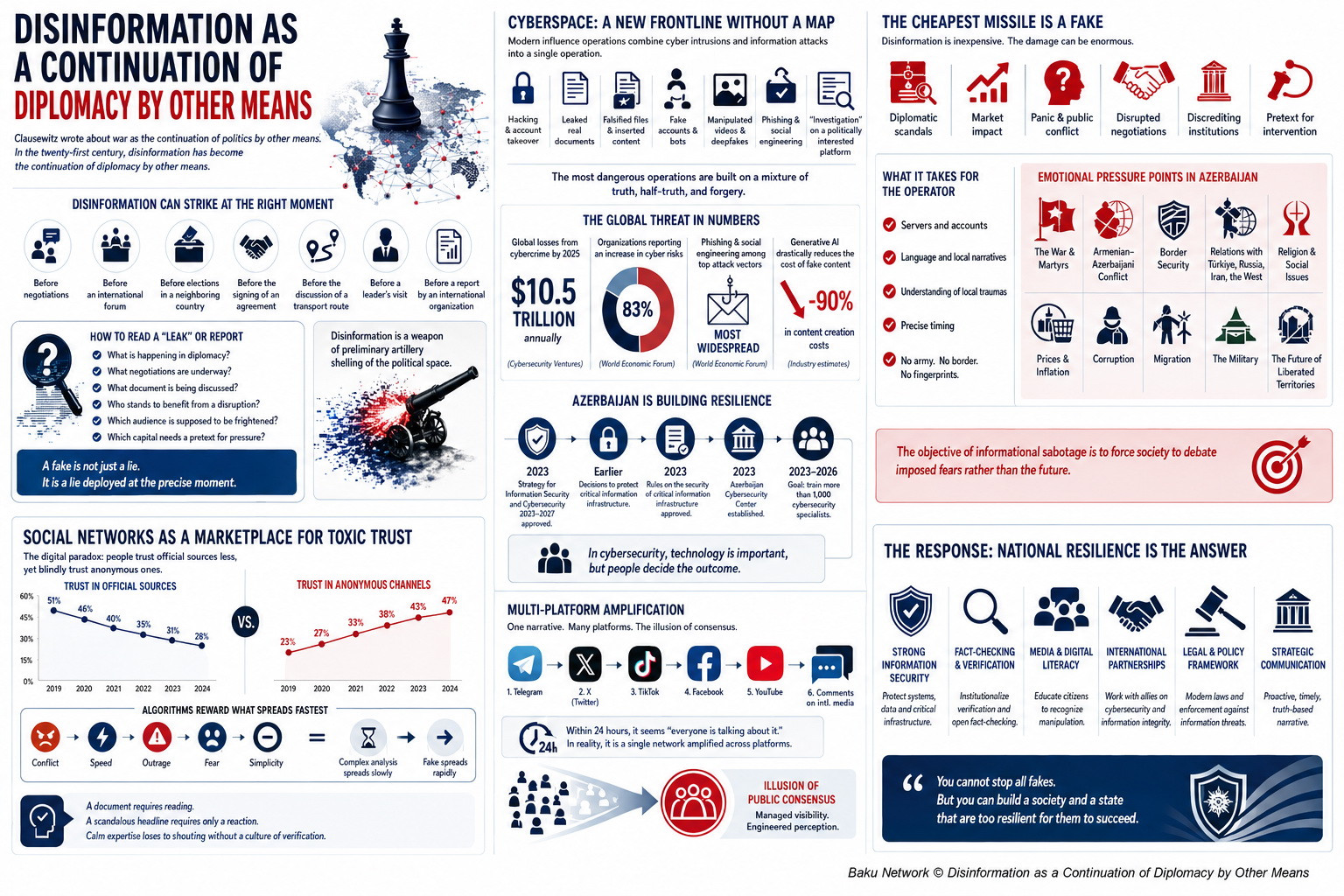
Clausewitz wrote about war as the continuation of politics by other means. In the twenty-first century, disinformation has become the continuation of diplomacy by other means. Especially where direct pressure appears too crude, and sanctions or military instruments are impossible or undesirable.
Today, a state can be attacked without declaring a crisis. It is enough to generate an information wave at the right moment: before negotiations, before an international forum, before elections in a neighboring country, before the signing of an agreement, before the discussion of a transport route, before a leader's visit, or before a report by an international organization.
In this sense, the timing of publication is often more important than the content itself. A fake is not just a lie. It is a lie deployed at the precise moment.
When reports are spread about allegedly covert weapon deliveries, secret agreements, preparation for provocations, oppression, threats, or a "new escalation," one must look not only at the text. One must look at the calendar. What is happening in diplomacy? What negotiations are underway? What document is being discussed? Who stands to benefit from a disruption? Which audience is supposed to be frightened? Which capital needs a pretext for pressure?
This is exactly how disinformation transforms into an instrument of preliminary artillery shelling of the political space.
Cyberspace: A New Frontline Without a Map
The problem of fake news is no longer separable from cybersecurity. Previously, it was possible to speak separately: here is journalism, here is information policy, and here are computer networks. Now, these boundaries have dissolved.
A modern influence operation can include hacking email accounts, leaking authentic documents, inserting falsified files, creating fake accounts, mass dissemination via bots, manipulated videos, deepfakes, contextual substitution, phishing emails, and subsequently publishing an "investigation" on a politically interested platform. Vulnerability arises not only where a lie is entirely fabricated. The most dangerous operations are often built on a mixture of truth, half-truth, and forgery.
Global statistics demonstrate the scale of the threat. According to international cyber experts, global losses from cybercrime by the middle of the decade are measured in trillions of dollars annually. The World Economic Forum, in its review of cyber risks, noted that the majority of organizations record an increase in cyber threats, with phishing and social engineering becoming some of the most widespread attack vectors. Generative artificial intelligence has sharply reduced the cost of producing fake content: now, a high-quality text, voice imitation, fake image, or video can be created not by a specialized studio, but by a small group of operators.
For Azerbaijan, this is particularly important. The state is actively digitalizing. Electronic government services, banking services, telecommunication networks, energy infrastructure, transport systems, media, and educational platforms - all of this creates convenience, but simultaneously expands the attack surface. The more modern a state becomes, the more digital doors it possesses. The adversary's task is to find not the main gates, but an unnoticed crack.
Azerbaijan is already building an institutional response. The Strategy for Information Security and Cybersecurity for 2023-2027, approved in 2023, became an important document precisely because it recognized that information security is not a secondary technical sphere, but a part of national resilience. Earlier, decisions were made to protect critical information infrastructure, and in 2023, rules related to its security were approved. The Azerbaijan Cybersecurity Center, opened in 2023, set the task of training more than a thousand specialists over three years. This is not a formal figure, but an indicator that the country understands the human resource nature of the threat. In cybersecurity, technology is important, but people decide the outcome.
The Cheapest Missile Is a Fake
Disinformation possesses a primary advantage: it is inexpensive, yet the damage can be immense. A single, well-targeted fake is capable of igniting a diplomatic scandal, striking the markets, sowing panic, disrupting negotiations, discrediting an institution, provoking public conflict, or creating a pretext for external intervention.
For a small group of operators, this is the ultimate weapon. There is no need to maintain an army. There is no need to cross a border. There is no need to leave fingerprints. All it takes are servers, accounts, language, an understanding of local traumas, and precise timing.
Azerbaijani society, like any other, has highly emotional topics: the war, the martyrs, the Armenian-Azerbaijani conflict, border security, relations with Türkiye, Russia, Iran, and the West, religion, social issues, prices, corruption, migration, the military, and the future of the liberated territories. Each of these themes can be turned into a pressure point. An external operator does not necessarily need a deep understanding of the country. It is enough for them to know where it hurts.
This is how informational sabotage is formed. Its objective is to force society to debate imposed fears rather than the future. While the state builds roads, restores life to the liberated territories, expands corridors, and concludes agreements, attempts are made to drag it into an endless defense against rumors, provocations, and artificial crises.
Social Networks as a Marketplace for Toxic Trust
The central paradox of the digital era is that people trust official sources less, yet frequently place defenseless trust in anonymous channels. Anonymity is perceived as courage, inside information as truth, and an emotional tone as proof of sincerity. This is precisely how the economy of fakes is constructed.
Social networks are no longer neutral platforms. Algorithms reward conflict, speed, outrage, fear, and simplicity. Complex analysis spreads slowly. A fake spreads rapidly. A document requires reading. A scandalous headline requires only a reaction. Calm expertise loses to shouting if the state and society fail to establish a culture of verification.
The problem is exacerbated by the fact that information attacks have become multi-platform. The exact same narrative can appear first on Telegram, then on X, subsequently on TikTok, then on Facebook, followed by YouTube, and eventually in the comment sections beneath international media publications. Within twenty-four hours, it appears as though "everyone is talking about it." In reality, it is a single network amplified across platforms.
This creates the illusion of a public consensus. A person encounters the same thesis in different places and concludes that since it is everywhere, there must be something to it. This is the mechanics of managed visibility.
Deepfakes: The Moment When Eyes Cease to Be Witnesses
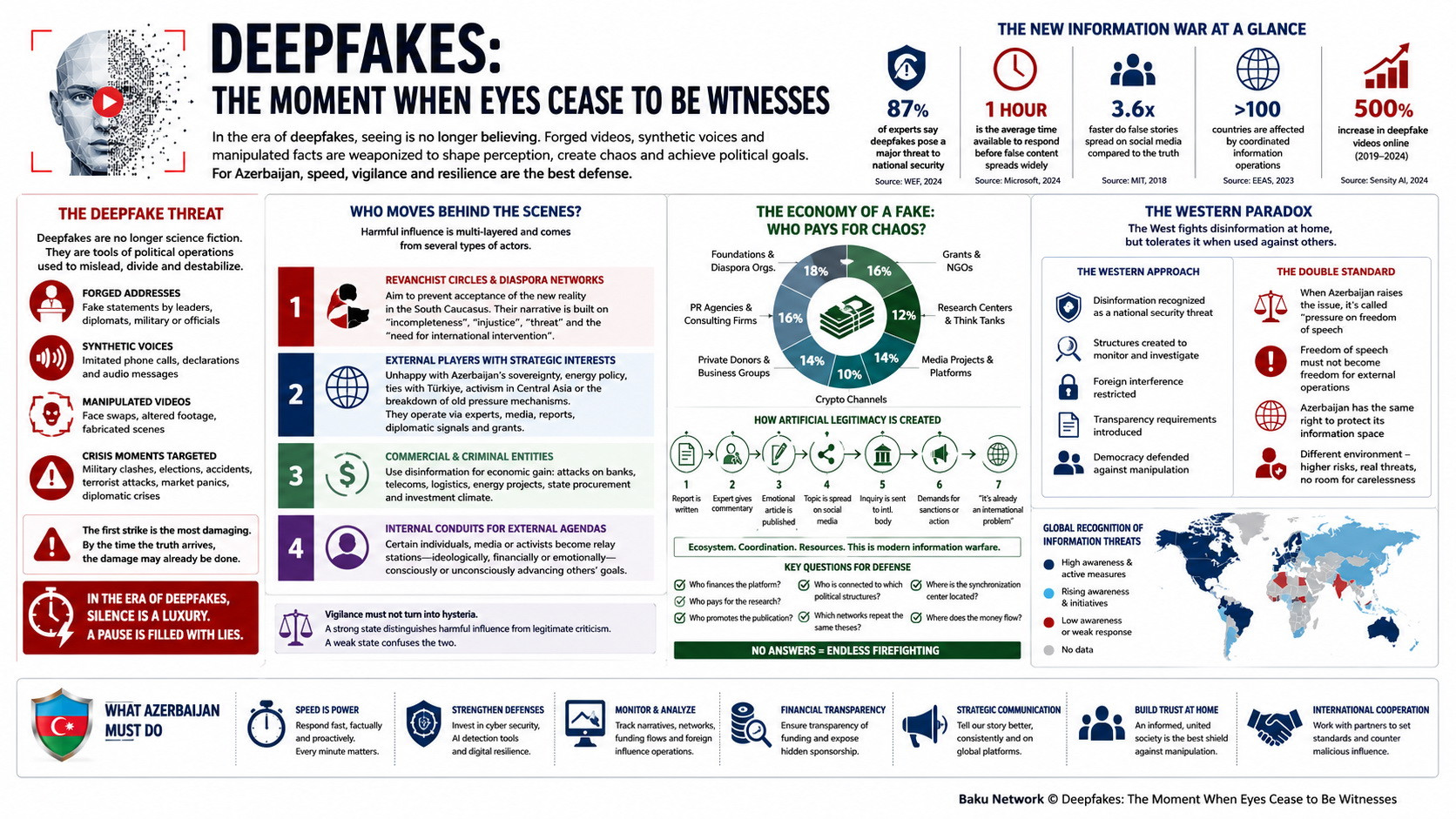
The most alarming aspect of the new information war is deepfakes. Previously, a photograph was considered proof. Then, people grew accustomed to photo manipulation. For a long time, video maintained the status of almost indisputable evidence. Today, that status is shattered.
A forged video address, a synthetically generated voice, a fake statement by a politician, an imitation of a telephone conversation, or the alteration of a face within genuine footage - none of this is science fiction anymore. These are the tools of political operations. Deepfakes are particularly dangerous during hours of crisis: during military clashes, mass events, diplomatic standoffs, accidents, terrorist attacks, elections, or banking panics.
For Azerbaijan, the risk is obvious. Imagine a falsified video containing an alleged statement by a state leader, military command, diplomat, representative of a law enforcement agency, or a foreign partner. Even if a refutation appears within an hour, the first strike has already landed. Markets, embassies, editorial offices, citizens, and international observers may have already reacted. In the digital environment, speed often outpaces the truth.
Therefore, state communication must be not only correct but also swift. In the era of deepfakes, silence is a luxury. A pause is filled with lies.
Who Moves Behind the Scenes
Various interest groups operate around Azerbaijan, and it would be simplistic to reduce everything to a single center. Harmful foreign influence is always multi-layered.
The first group consists of revanchist Armenian circles and their associated diaspora structures. Their objective is clear: to prevent the world from definitively accepting the new reality of the South Caucasus. For them, the information war becomes a method of continuing a failed political and military strategy. The narrative is constructed around the ideas of "incompleteness," "injustice," "threat," and the "necessity of international intervention." The firmer the peace agenda becomes, the stronger their desire to disrupt it through emotional campaigns.
The second group includes external players who find the full sovereignty of Azerbaijan disadvantageous. For some, Baku is too close to Türkiye. For others, it is too independent in its energy policy. For a third group, it is too active in Central Asia. For a fourth, it has successfully dismantled old mechanisms of regional pressure. These forces do not always act openly. They often prefer to operate through expert networks, grant structures, media platforms, reports, and diplomatic signals.
The third group comprises commercial and criminal entities. Disinformation can be utilized not only in politics but also in business: attacks on banks, telecommunications, logistics, energy projects, state procurement, and the investment climate. A reputational blow to a country can have a direct economic dimension.
The fourth group consists of internal conduits for an external agenda. This is the most complex category. Not every critic is an agent of influence, and the state must not substitute analysis with suspicion. However, a genuine problem exists when certain public figures, media outlets, or network activists consciously or unconsciously become relay stations for someone else's strategic line. Sometimes this stems from ideological motives, sometimes from personal grievances, sometimes from financial dependence, and sometimes from a desire to gain external legitimacy.
This is precisely why vigilance must not turn into hysteria. A strong state distinguishes harmful influence from legitimate criticism. Conversely, a weak state frequently confuses the two. Azerbaijan needs to be strong in exactly this sense: unyielding toward influence operations and sufficiently confident not to fear honest expertise.
The Economy of a Fake: Who Pays for Chaos
Behind any sustained information campaign lies a resource. Accounts must be created, content produced, translations executed, experts engaged, advertising purchased, platforms maintained, legal protection secured, and relations with editorial offices sustained. Even "spontaneous public outrage" often has a budget.
Funds can flow through foundations, diaspora organizations, PR agencies, research centers, media projects, consulting firms, private donors, business groups, and cryptocurrency channels. A modern influence operation rarely looks like a direct order. It operates as an ecosystem. One person writes a report. Another provides a commentary. A third publishes an emotional column. A fourth introduces the topic to social media. A fifth submits an inquiry to an international body. A sixth demands sanctions. A seventh states, "Look, this is already an international problem."
This is how artificial legitimacy is generated.
In this regard, Azerbaijan must strengthen not only its cyber defense but also its financial and analytical monitoring of information campaigns. The issue is not about silencing dissent. The issue is the transparency of the origin of influence. Who finances the platform? Who pays for the research? Who promotes the publication? Who is connected to which political structures? Which networks repeat the exact same theses? Where is the synchronization center located?
Without answers to these questions, the fight against fakes turns into endless firefighting.
The Western Paradox: Fighting Disinformation at Home and Tolerating It Against Others
There is another crucial aspect. Western states have long viewed disinformation as a threat to national security. The European External Action Service, in its reports on information manipulation, speaks of the global scale of the problem and notes that such operations affect dozens and even more than a hundred countries. France, Germany, the United States, the United Kingdom, the Baltic states, and the European Union - all of them establish structures to counter foreign interference, monitor platforms, investigate networks of influence, restrict specific channels, and introduce transparency requirements.
Yet, as soon as a similar topic is raised by Azerbaijan, a portion of the Western discourse alters its tone. What is labeled in Paris, Berlin, or Washington as the defense of democracy against interference is sometimes presented in relation to Baku as "pressure on freedom of speech." This is a double standard that cannot be ignored.
Of course, the fight against fakes must not become an excuse for arbitrary actions. However, freedom of speech must not turn into an indulgence for external operations either. Democratic societies themselves acknowledge that foreign informational interference exists, that it is dangerous, and that it requires an institutional response. Consequently, Azerbaijan possesses the exact same right to protect its information space as France, the United States, or Germany.
The only difference is that Azerbaijan operates in a much harsher geopolitical environment. It borders zones of instability, has endured decades of conflict, has faced occupation, possesses a complex regional neighborhood, and stands as an object of competing interests among major players. For such a country, informational carelessness is not liberalism; it is a luxury for which security could be the price.
Media as Defensive Infrastructure
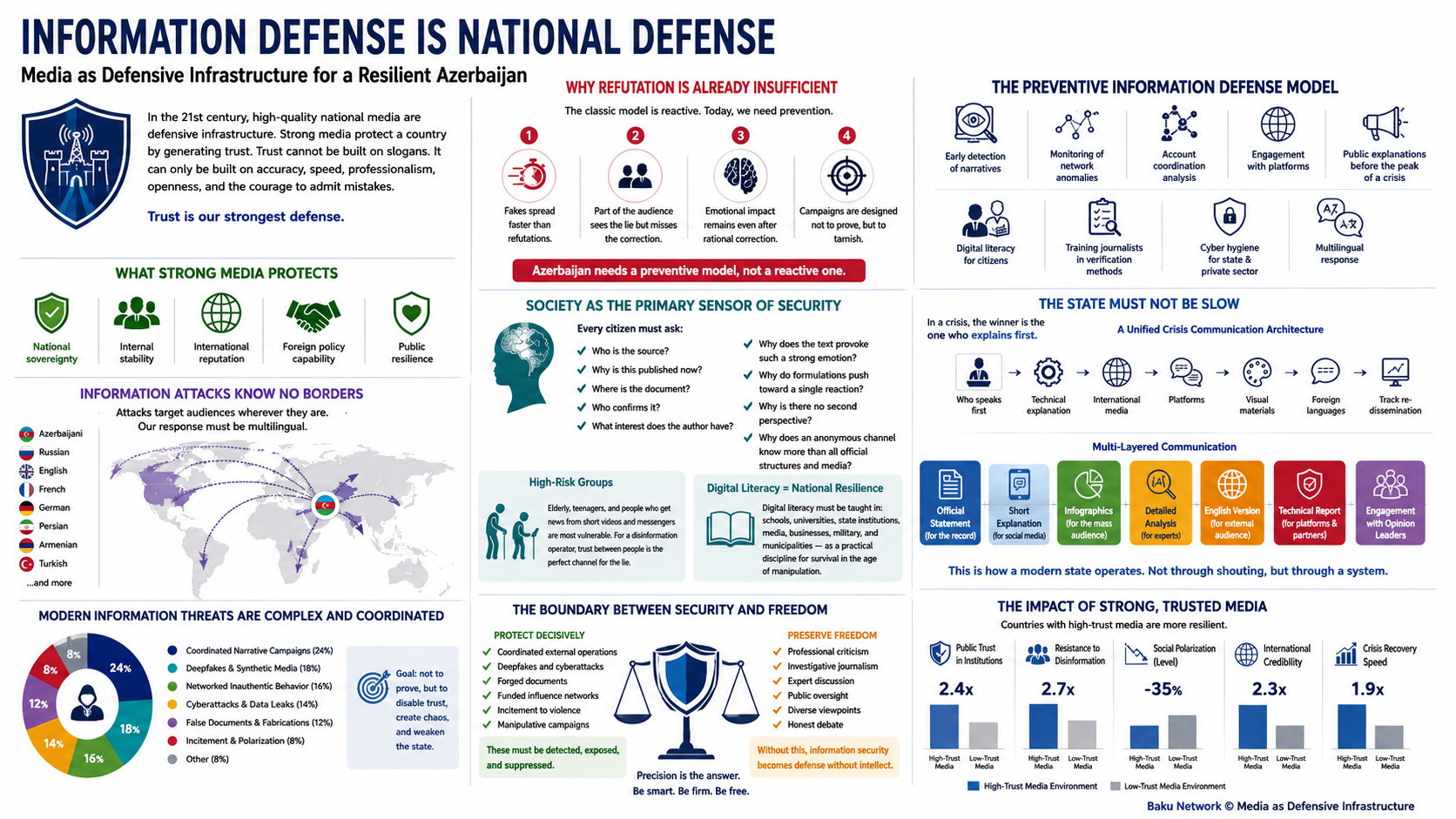
Defensive infrastructure is typically envisioned as radars, fortifications, bases, communication systems, drones, and air defense. Yet in the twenty-first century, high-quality national media are also defensive infrastructure. This is not because they should serve as a mouthpiece for the state. On the contrary, weak propaganda does not protect; it discredits. Strong media protect a country by generating trust.
Trust cannot be built on slogans. It can only be built on accuracy, speed, professionalism, an openness to difficult questions, respect for the audience, and the capacity to admit mistakes. If official communication is slow, dry, and formal, the vacuum is filled by Telegram. If national analysis is simplistic, the audience migrates to external interpreters. If journalism fails to explain complex processes, society becomes prey for emotional manipulators.
Azerbaijan requires a new culture of strategic communication. Not a Soviet intonation, not a bureaucratic press release, and not the endless repetition of correct formulas, but a modern system for explaining reality. The state must speak quickly, accurately, and in human terms. The expert community must be capable of decoding intricate processes. The media must not simply relay statements but demonstrate the context, motives, interests, and risks.
This is precisely where the boundary runs between informational defense and informational vulnerability.
Why Refutation Is Already Insufficient
Classical anti-fake efforts were built around refutation: a lie emerged, and it was debunked. Today, this is not enough.
First, a fake spreads faster than its refutation. Second, a portion of the audience witnesses the lie but misses the subsequent explanation. Third, an emotional trace remains even after a rational correction. Fourth, campaign organizers frequently calculate for precisely this outcome: not to prove, but to tarnish.
Therefore, Azerbaijan requires a preventive model rather than a reactive one.
It must encompass the early detection of narratives, monitoring of network anomalies, analysis of account coordination, engagement with platforms, preparation of public explanations prior to the peak of a crisis, digital literacy among citizens, training journalists in verification methods, and strengthening cyber hygiene within both state structures and the private sector.
The work with languages carries particular significance. Attacks against Azerbaijan are frequently conducted not only in Azerbaijani and Russian, but also in English, French, German, Persian, Armenian, and Turkish. Foreign influence operates wherever the target audience is located. Consequently, the response must also be multilingual. It is insufficient to refute a fake within the country if its primary target is a Brussels bureaucrat, a Paris editor, or a Washington analyst.
Society as the Primary Sensor of Security
No agency, no monitoring center, and no state structure can halt disinformation alone if society does not possess immunity. Information security does not begin in a server room; it begins in the mind of the citizen.
An individual must ask simple questions: Who is the source? Why is this published now? Where is the document? Who confirms it? What interest does the author have? Why does the text provoke such a strong emotion? Why do all the formulations push toward a single reaction? Why is there no second perspective? Why does an anonymous channel know more than all official structures and professional editorial offices?
Digital literacy must not be an elective for school children. It must become a component of national resilience. It needs to be taught in schools, universities, state institutions, editorial offices, businesses, the military, and municipalities. Not as a tedious course on a "safe internet," but as a practical discipline for survival in the era of manipulation.
A specific risk group comprises the elderly, teenagers, and individuals who receive news predominantly from short videos and messengers. It is precisely there that fakes spread with particular speed. A relative forwards a message to a relative, a neighbor to a neighbor, an acquaintance to an acquaintance. Trust is based not on the source, but on the personal connection. For a disinformation operator, this is an ideal environment: the lie receives a human face.
The State Must Not Be Slow
The speed of reaction is a matter of authority. In a crisis, the winner is not simply the one who is right, but the one who manages to be the first to explain what is occurring. If the state remains silent, enemies, competitors, alarmists, and amateurs will speak in its stead.
A unified crisis communication architecture is required. Not chaotic statements from various departments, but a coordinated system. In the event of a major fake or an information attack, it must be clear who speaks first, who provides the technical explanation, who works with international media, who addresses the platforms, who prepares visual materials, who responds in foreign languages, and who tracks re-dissemination.
Strong communication must be multi-layered. An official statement - for the record. A short explanation - for social networks. Infographics - for the mass audience. Detailed analysis - for experts. An English version - for the external audience. A technical report - for platforms and partners. Engagement with opinion leaders - for dissemination.
This is how a modern state operates. Not through shouting, but through a system.
The Boundary Between Security and Freedom
The most complex question is where the boundary runs between protection from harmful influence and excessive control. The answer cannot be simplistic. Any country facing hybrid threats is compelled to resolve this dilemma.
It is crucial for Azerbaijan to prevent two errors.
The first error is naivety. To pretend that foreign informational interference does not exist is to ignore reality. It exists. It is directed against the sovereignty, reputation, internal stability, and foreign policy capabilities of the country.
The second error is harshness. To perceive harmful influence in any criticism is to weaken one's own intellectual system. A society where it is impossible to discuss problems becomes less resilient because genuine vulnerabilities retreat into the shadows. An external adversary utilizes precisely closed topics: where there is no honest conversation, a rumor grows more easily.
The optimal model is precision. Coordinated external operations, deepfakes, cyberattacks, forged documents, funded networks of influence, incitements to violence, and manipulative campaigns in the interests of foreign centers must be strictly suppressed. Simultaneously, the space for professional criticism, investigations, expert discussion, and public oversight must be preserved. Without this, information security transforms into a defense devoid of intellect.
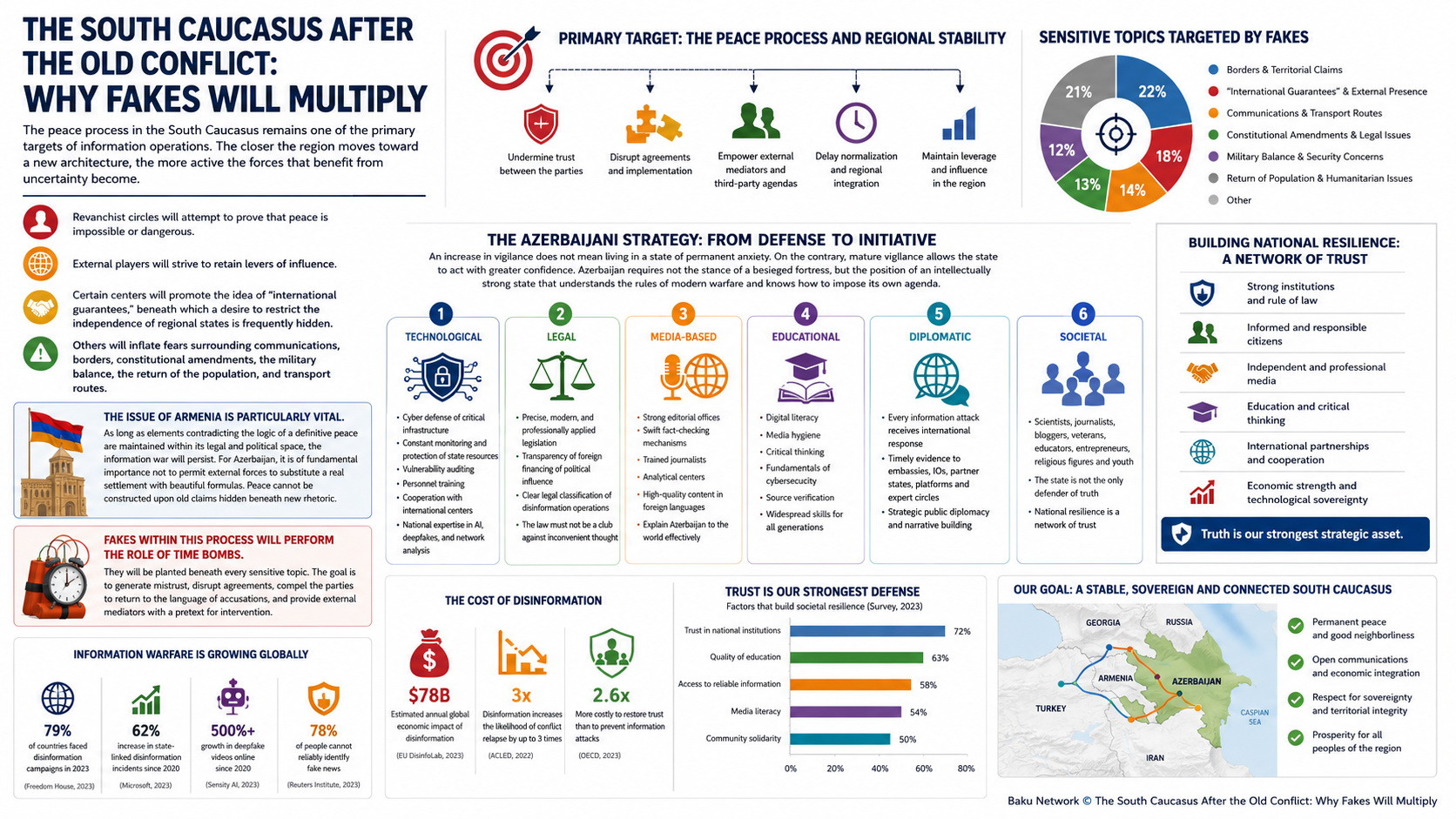
The South Caucasus After the Old Conflict: Why Fakes Will Multiply
The peace process in the South Caucasus remains one of the primary targets of information operations. The closer the region moves toward a new architecture, the more active the forces that benefit from uncertainty become.
Revanchist circles will attempt to prove that peace is impossible or dangerous. External players will strive to retain levers of influence. Certain centers will promote the idea of "international guarantees," beneath which a desire to restrict the independence of regional states is frequently hidden. Others will inflate fears surrounding communications, borders, constitutional amendments, the military balance, the return of the population, and transport routes.
The issue of Armenia is particularly vital. As long as elements contradicting the logic of a definitive peace are maintained within its legal and political space, the information war will persist. For Azerbaijan, it is of fundamental importance not to permit external forces to substitute a real settlement with beautiful formulas. Peace cannot be constructed upon old claims hidden beneath new rhetoric.
Fakes within this process will perform the role of time bombs. They will be planted beneath every sensitive topic. The goal is to generate mistrust, disrupt agreements, compel the parties to return to the language of accusations, and provide external mediators with a pretext for intervention.
The Azerbaijani Strategy: From Defense to Initiative
An increase in vigilance does not mean living in a state of permanent anxiety. On the contrary, mature vigilance allows the state to act with greater confidence. Azerbaijan requires not the stance of a besieged fortress, but the position of an intellectually strong state that understands the rules of modern warfare and knows how to impose its own agenda.
This strategy must encompass several directions.
The first is technological. Cyber defense of critical infrastructure, constant monitoring, protection of state resources, auditing of vulnerabilities, training of personnel, cooperation with international centers, and the development of national expertise in the fields of artificial intelligence, deepfakes, and network analysis.
The second is legal. Legislation must be precise, modern, and applied professionally rather than selectively. Foreign financing of political influence must be transparent. Disinformation operations must carry a clear legal classification. However, the law must not transform into a club deployed against any inconvenient thought.
The third is media-based. Strong editorial offices, swift fact-checking mechanisms, trained journalists, analytical centers, and high-quality content in foreign languages are required. Azerbaijan must explain itself to the world no less effectively than its adversaries attempt to distort it.
The fourth is educational. Digital literacy, media hygiene, critical thinking, the fundamentals of cybersecurity, and source verification must become widespread skills.
The fifth is diplomatic. Every major informational attack against Azerbaijan must receive not only an internal refutation but also foreign policy accompaniment. Embassies, international organizations, partner states, platforms, and expert circles must receive the evidentiary base in a timely manner.
The sixth is societal. The state cannot serve as the sole defender of truth. This system requires scientists, journalists, bloggers, veterans, educators, entrepreneurs, religious figures, and youth. National resilience is a network of trust.
The Most Dangerous Lie Is the One That Resembles the Truth
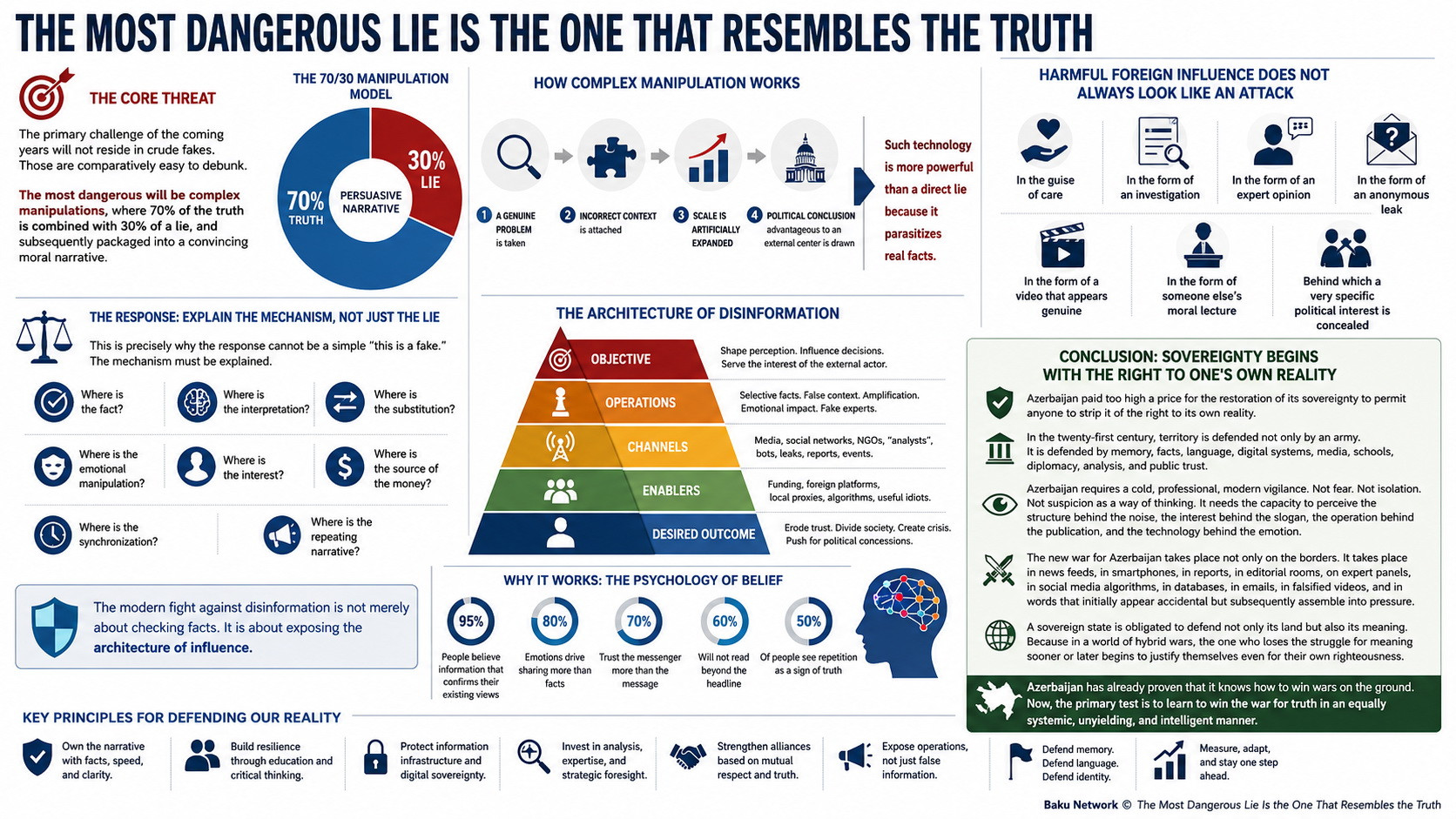
The primary challenge of the coming years will not reside in crude fakes. Those are comparatively easy to debunk. The most dangerous will be complex manipulations, where seventy percent of the truth is combined with thirty percent of a lie, and subsequently packaged into a convincing moral narrative.
For instance, a genuine problem is taken, an incorrect context is attached to it, the scale is artificially expanded, and then a political conclusion advantageous to an external center is drawn. Such technology is more powerful than a direct lie because it parasitizes real facts.
This is precisely why the response cannot be a simple "this is a fake." The mechanism must be explained. Where is the fact? Where is the interpretation? Where is the substitution? Where is the emotional manipulation? Where is the interest? Where is the source of the money? Where is the synchronization? Where is the repeating narrative?
The modern fight against disinformation is not merely about checking facts. It is about exposing the architecture of influence.
Conclusion: Sovereignty Begins with the Right to One's Own Reality
Azerbaijan paid too high a price for the restoration of its sovereignty to permit anyone to strip it of the right to its own reality. In the twenty-first century, territory is defended not only by an army. It is defended by memory, facts, language, digital systems, media, schools, diplomacy, analysis, and public trust.
Harmful foreign influence is dangerous precisely because it does not always present itself as an attack. Sometimes it arrives in the guise of care. Sometimes - in the form of an investigation. Sometimes - in the form of an expert opinion. Sometimes - in the form of an anonymous leak. Sometimes - in the form of a video that appears genuine. Sometimes - in the form of someone else's moral lecture, behind which a very specific political interest is concealed.
Azerbaijan requires a cold, professional, modern vigilance. Not fear. Not isolation. Not suspicion as a way of thinking. It needs the capacity to perceive the structure behind the noise, the interest behind the slogan, the operation behind the publication, and the technology behind the emotion.
The new war for Azerbaijan takes place not only on the borders. It takes place in news feeds, in smartphones, in reports, in editorial rooms, on expert panels, in social media algorithms, in databases, in emails, in falsified videos, and in words that initially appear accidental but subsequently assemble into pressure.
A sovereign state is obligated to defend not only its land but also its meaning. Because in a world of hybrid wars, the one who loses the struggle for meaning sooner or later begins to justify themselves even for their own righteousness.
Azerbaijan has already proven that it knows how to win wars on the ground. Now, the primary test is to learn to win the war for truth in an equally systemic, unyielding, and intelligent manner.