

When political regimes collapse, it almost never happens under pressure from the outside. The history of authoritarian and quasi-theocratic systems points to a different pattern: the final crisis begins with internal decay, with the erosion of loyalty mechanisms that once held the system together. Taliban-run Afghanistan has now reached that threshold.
The fall of the previous government in 2021 and the withdrawal of U.S. forces created a rare moment of power consolidation. The Islamic Emirate was proclaimed as a finished, monolithic project - seemingly free of factional strife. By early 2025, however, it had become clear that the gravest threat to the regime was not external pressure but the structure of its own governance.
Supreme Leader Hibatullah Akhundzada’s public warning about “internal enemies within the government” was a rare breach in an otherwise sealed system - a leak of strategic anxiety. His admission that internal disagreements could bring down the emirate was not rhetorical posturing meant to discipline the ranks. It was a clinical diagnosis.
At its core, Afghanistan is now witnessing a clash between two incompatible visions of its future. The first is the Kandahar model, built around Akhundzada himself. It calls for radical centralization, the sacralization of the emir’s authority, and the deliberate isolation of the country from the modern world. In this framework, religious bodies supplant state institutions, and accountability exists only along a single vertical line: emir to God.
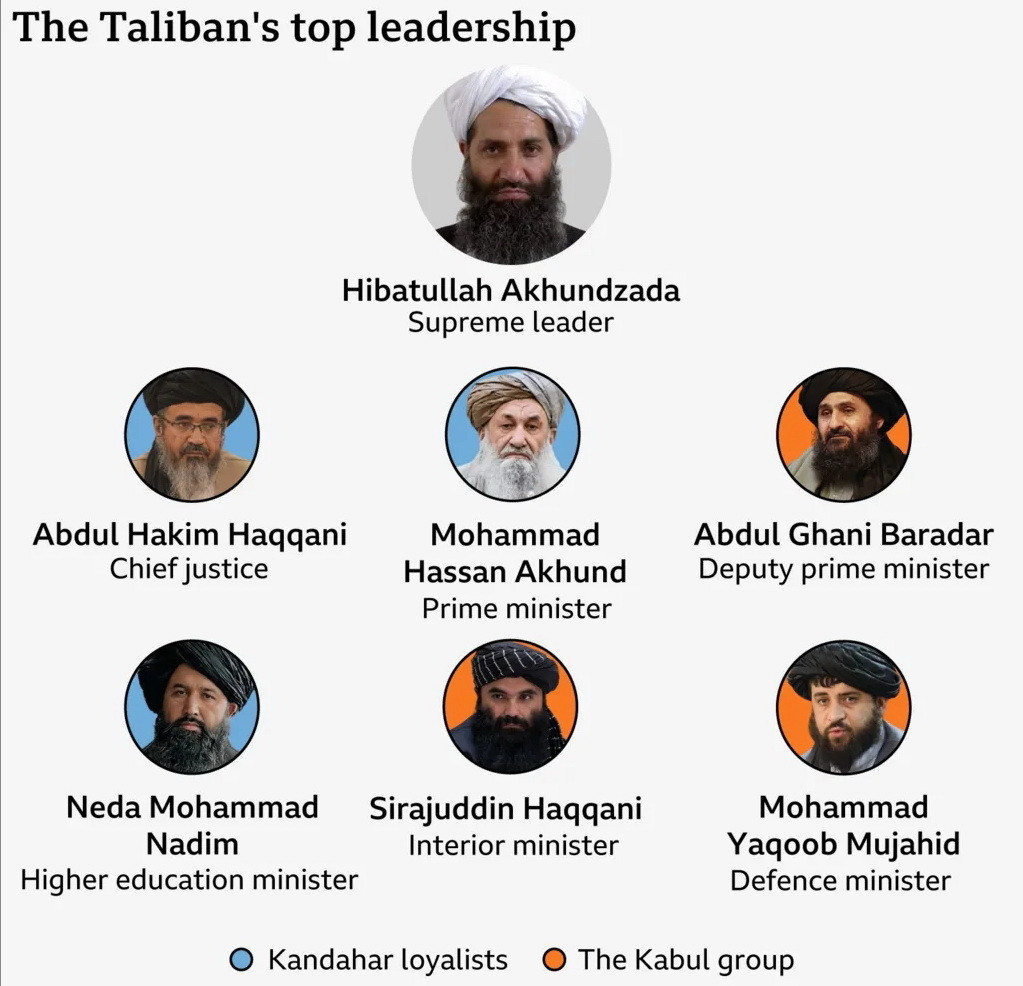
The second model has taken shape in Kabul. Its proponents are neither Western-style reformers nor liberals. They are pragmatists from within the movement. For them, the regime’s survival depends on a minimum level of institutional functionality - an economy that doesn’t collapse entirely, manageable communications, limited engagement with the outside world, and basic education, including schooling for girls and women within a tightly interpreted version of sharia. This is not ideological humanism. It is cold calculation.
Until recently, this conflict remained latent. The movement’s DNA has always been built around unconditional obedience. Internal debates could be fierce, but they stayed behind closed doors. The supreme leader was considered untouchable - beyond challenge, politically or theologically.
That is precisely why the September decision to shut down the internet marked a turning point.
Officially, it was framed as an assertion of sovereignty. Unofficially, it was a display of absolute power. Cutting off connectivity meant severing Afghanistan from the outside world while sending a blunt message to the elite: the center of decision-making is in Kandahar, not Kabul.
Then something happened that, in the context of such a regime, can only be described as institutional rebellion.
Three days later, the internet was restored - without explanation, without public statements. In effect, the supreme leader’s order was quietly nullified. Not rhetorically, but in practice.
From the standpoint of political theory, this episode matters far more than any ideological dispute. For the first time in the movement’s history, the foundational principle of unconditional obedience was broken. And it wasn’t the work of a marginal faction. It was carried out by key figures in the executive apparatus - actors with resources, influence, and backing inside the system.
This cannot be dismissed as a technical fix or a temporary adjustment. It was a symbolic rupture. The internal struggle moved from interpretation to action.
It bears emphasizing: this is not a split in the classic sense. There is no alternative leader, no open opposition, no manifesto. What exists instead is far more dangerous - the erosion of the obedience vertical itself. When an order can be ignored because it undermines governability, the regime ceases to be sacred and becomes negotiable.
For closed ideocratic systems, that is lethal. They can survive for decades under sanctions, isolation, and external pressure. What they almost never survive is the moment when disobedience becomes permissible within the elite.
From this point on, any subsequent crisis - economic, humanitarian, or security-related - will be amplified by that single factor. Not because Kabul is pushing modernization, but because the very idea of absolute authority is no longer unquestioned.
Akhundzada understands this. His warning about the possible collapse of the emirate sounds less like prophecy than like an acknowledgment of systemic risk. The question now is not whether one faction will defeat another. The question is whether the Islamic Emirate can preserve the governing model on which it was built at all.
History offers a clear answer. When absolute power collides with pragmatic defiance, it is no longer a battle of ideas. It is the beginning of a transformation that cannot be stopped - not even by an order issued in the name of the emir himself.
A Man of Faith as a Political Force: How the Sacralization of Power Is Reshaping the Islamic Emirate
Hibatullah Akhundzada does not fit any familiar mold of a political leader. He did not rise as a battlefield commander, did not earn authority through military victories, and never cultivated the aura of a charismatic warlord. His ascent followed a different trajectory - slow, institutional, and, most importantly, ideological.
When Akhundzada was selected as the Taliban’s supreme leader in 2016, his candidacy was widely seen as a compromise. Inside the movement, he was viewed primarily as a religious arbiter, someone capable of balancing rival centers of influence. His lack of combat credentials was not considered a weakness but an asset: he belonged to none of the military factions and could therefore stand above them.
That logic shaped the original architecture of power. His deputies were two figures of symbolic and functional weight: Sirajuddin Haqqani, the embodiment of the movement’s hard military wing, and Mohammad Yaqoob Mujahid, the bearer of dynastic legitimacy as the son of the Taliban’s founder. This triumvirate provided internal balance, enabling negotiations with Washington, the signing of the 2020 agreement, and the exploitation of the strategic vacuum that followed the U.S. withdrawal in August 2021.
At that stage, the movement appeared monolithic. To outside observers, Taliban rule looked collective, albeit rigidly ideological. But the return to the day-to-day realities of governing a state quickly altered the internal dynamic.
Once in power, both deputies were effectively downgraded to ministerial roles. Even Abdul Ghani Baradar, one of the architects of the negotiating process, was reduced to a vice-premier with little independent influence. The center of decision-making did not merely shift - it was deliberately removed from the capital.
Akhundzada’s refusal to reside in Kabul in favor of Kandahar was neither a security precaution nor a nod to tradition. It was a calculated strategic move: the creation of a parallel state within the state. Kandahar became a sacral core of power, insulated from administrative routine, international engagement, and the pressures of everyday governance.
From that point on, consolidation followed methodically. Akhundzada surrounded himself with ideologically aligned loyalists, concentrating control over the judiciary, religious policy, security structures, and key sectors of the economy. Decrees were issued without cabinet consultation. Earlier public commitments - including those related to girls’ education and women’s participation in public life - were effectively nullified.
This course was not a reaction to external pressure. It reflected Akhundzada’s own internal evolution. Beginning his career as a sharia court judge in the 1990s, he gradually embraced a dogmatic, uncompromising view of power and responsibility. According to those familiar with his thinking, his worldview centers on personal accountability before God for every decision made - or avoided. Within that logic, compromise ceases to be a political tool and becomes a threat to moral purity.
The story of his son is revealing. The young man volunteered as a suicide bomber. Akhundzada not only knew of the decision but blessed it, seeing it not as tragedy but as an act of supreme faith. Experiences of this kind produce a particular type of authority - one in which human and social costs are irrelevant, and only spiritual duty matters.
Outwardly, this model is reinforced by near-monastic seclusion. Akhundzada avoids public appearances, never addresses the population directly, communicates through a narrow circle of clerics, conceals his face, and bans photography and video. Physical inaccessibility becomes part of the cult. In a system where religion is the source of legitimacy, distance itself turns into power.
Governance practices have shifted accordingly. The cabinet in Kabul has lost direct access to the supreme leader. Ministers wait weeks for an audience; invitations to Kandahar are privileges reserved for the chosen few. Key portfolios, including control over weapons, have been brought under the direct supervision of the Kandahar circle. Orders are increasingly issued straight to local authorities, bypassing formal hierarchies.
What follows is the dismantling of the classic cabinet system. The executive branch still exists on paper, but its autonomy is rapidly shrinking. By the movement’s own admission, under their interpretation of sharia Akhundzada holds absolute authority, and his decisions are not subject to debate - for the sake of preventing division.
The paradox is that this concentration of power generates internal tension. The Kabul-based leadership does not dispute the emir’s religious authority, but it faces the practical impossibility of running a country under total centralization and ideological maximalism.
Akhundzada is no longer a consensus figure. He has become the apex of a new vertical, where faith displaces institutions and sacral responsibility replaces political rationality. This is not merely a governing style; it is a fundamental transformation of the regime’s nature.
Seen in this light, subsequent developments - from disputes over education to episodes of open defiance over communications policy - no longer appear accidental. They are the direct consequence of turning a man of faith into the absolute center of power, where politics dissolves into religious dogma.
People Who Have “Seen the World”: The Pragmatic Challenge to Sacralized Authority
Internal dissent at the top of the Taliban has never taken the form of an ideological alternative. It grew out of experience. The Kabul group consists of men who have seen Afghanistan not only from madrassas and mountain hideouts, but from negotiating tables, airports, foreign capitals, and television studios. That exposure bred strategic skepticism: the current governing model, they believe, is unsustainable in the long run.
In their vision, Afghanistan’s future is neither liberal democracy nor the abandonment of sharia. It is a functional Islamic state modeled on the Gulf monarchies - strict and religious, yet integrated into the global economy, with working institutions, managed communications, and predictable rules. This is not moderation; it is pragmatism stripped of idealism.
That is why the concentration of power in Kandahar alarms them. Their concern is not centralization per se, but the nature of the decisions being made: “virtue” laws, repressive interpretations of religious norms, total intrusion into private life, and severe restrictions on women’s education and employment. In their assessment, these measures do not strengthen the regime - they hollow it out, cutting off economic and diplomatic lifelines.
It bears stressing that the Kabul group is not pursuing reform in the Western sense. This is not a human-rights movement; it is a case for governability. Internal sources describe them as “pragmatists,” not “moderates.” Their informal gravitational center remains Abdul Ghani Baradar, a co-founder of the movement and chief negotiator with the United States, to whom many elites still feel personal loyalty. It is no accident that during the 2024 campaign debates, Donald Trump referred to Baradar as “the head of the Taliban,” oversimplifying but capturing a certain political intuition.
This group understands the power of symbols and media. The contrast with the past is striking even to them. Those who once smashed televisions now make active use of TV and social media. A younger generation of Taliban members, along with segments of society, increasingly orients itself toward recognizable faces rather than anonymous clerics.
Mohammad Yaqoob Mujahid, the founder’s son, is gaining popularity not only within the bureaucracy but beyond it. His image circulates widely on social platforms, becoming part of a new, personalized and visual political culture. For a movement that historically rejected any cult of personality, this marks an unprecedented shift.
Most striking, however, has been the transformation of Sirajuddin Haqqani. Not long ago, he was a near-mythical figure of the insurgency - a faceless symbol of elusiveness and ruthless resistance. His network was responsible for some of the bloodiest attacks of the war, including bombings that killed dozens of civilians. For years, only a single verified photograph existed.
Then he stepped before the cameras. Unmasked, openly, as a statesman. It was a deliberate break with his former image. Haqqani ceased to be merely a commander and became a public minister - a politician interviewed by Western media and cautiously discussed as a possible channel for the regime’s evolution. Notably, the bounty on his head was lifted soon after.
Yet neither Haqqani nor anyone else in the Kabul group is prepared to openly challenge the supreme leader. In a system where obedience to Akhundzada is framed as a religious duty, open conflict remains taboo. Even expressions of dissent were long confined to microscopic acts - selective noncompliance with minor orders at the local level, nothing more.
Publicly, Haqqani emphasizes unity and downplays any hint of internal discord. This rhetoric is aimed as much at the outside world as at the elite. For a long time, the Kabul group’s message was cautious: we see the problems, we hear the criticism, but our room for maneuver is limited.
Thus a fragile balance held between the sacral vertical and pragmatic governance - until the order to shut down the internet.
That directive became the dividing line, the moment when a strategy of silent disagreement collided with an unavoidable choice. From that instant, latent tension ceased to be abstract. The issue was no longer competing visions of Afghanistan’s future, but the permissibility of disobedience itself - even when undertaken in the name of saving the regime.
The Breaking Point: When an Order Stopped Being Destiny
Every ideocratic system has a line where faith collides with the realities of governance. For the Islamic Emirate, that line ran straight through the internet.
Hibatullah Akhundzada has never concealed his view of the digital world. To him, the internet is not a tool but a threat - a conduit for ideas that contradict Islamic teaching, a source of moral corruption, and a channel for uncontrolled external influence. According to people close to him, Akhundzada deliberately avoids direct contact with the digital sphere: aides read him the news and social media content aloud each day. This is not eccentricity. It is the expression of a worldview in which technology itself is treated as a test of faith.
For the Kabul group, the picture looks entirely different. In their understanding, a state without the internet is not an Islamic virtue but an administrative disaster. The economy, finance, logistics, diplomacy - even basic governance - are impossible without connectivity. Faith is not rejected, but subordinated to the regime’s survival.
The order to shut down the internet was not impulsive. It was rolled out in stages. First, it was imposed in several provinces controlled by Akhundzada’s allies - a test of reactions, manageability, obedience. Then, in late September, it was extended nationwide. The wording was unambiguous: no exceptions, no justifications.
That was the moment when internal tension crossed into a fundamentally new phase.
Even before the nationwide blackout, Abdul Ghani Baradar, the de facto leader of the Kabul camp, tried to halt the process. He traveled to Kandahar, attempting - through loyal governors - to convey a simple but, in this system, almost heretical idea: the supreme leader needed to be “woken up.” The time had come to stop being silent executors and dare to speak the truth, even if it was unwelcome.
The response was predictable. His message was dismissed. The Kandahar vertical was not prepared for feedback. On Monday, September 29, the Ministry of Telecommunications received a direct order from the supreme leader: shut everything down. No discussion. No compromise.
What followed would have seemed unthinkable in the Taliban’s history just weeks earlier.
On Wednesday morning, the key figures of the Kabul group - Baradar, Sirajuddin Haqqani, Mohammad Yaqoob - gathered in the office of Prime Minister Mullah Hassan Akhund, a man from the Kandahar camp. The minister of telecommunications joined them. This was not a request or a debate. It was collective pressure.
Their argument was starkly pragmatic - and therefore devastating to the sacral logic of power. They would take responsibility themselves. Not the emir. Not God. Themselves - as those running the country. In effect, the prime minister was presented with a choice: remain the formal executor of an order that would lead to systemic collapse, or assume political responsibility for canceling it.
He chose the latter.
The internet was restored. No public statement. No ideological justification. It was simply switched back on.
In the regime’s internal logic, this was not a technical episode but a tectonic shift. For the first time in the history of the Islamic Emirate, a direct order from the supreme leader was effectively nullified - not by him, and not under external pressure, but by a decision taken by a group of ministers.
This was the breaking point.
Not because the internet proved more important than ideology, but because the sacred axiom of absolute obedience was breached. Until that moment, sacralized power could be harsh, irrational, unbearable - but it remained unquestionable. Afterward, it became subject to internal balance and calculation.
It is crucial to stress: this was not a mutiny or a split. No one openly challenged Akhundzada. No one questioned his religious authority. But the boundary of what was permissible shifted. A precedent emerged in which pragmatic necessity outweighed literal obedience to the emir’s will.
For closed ideological systems, such precedents are more dangerous than any sanctions. They do not topple power overnight. They quietly transform it from within. From that moment on, every new order will be weighed not only against faith, but against consequences.
And that is the central intrigue of Afghanistan’s future: can a man of faith retain absolute authority in a system where it has now been proven - once - that an order can be undone when the survival of the regime itself is at stake.
A Crack from Within: When the Threat to Unity Stops Being Abstract
The events surrounding the shutdown - and subsequent restoration - of the internet mattered not only in their own right. What proved far more consequential was that, over the course of a few days, a warning issued months earlier by Hibatullah Akhundzada materialized in practice. The threat to the movement’s unity did, in fact, emerge from within - not as a conspiracy, not as a factional revolt, but as managerial disobedience.
Until then, the system had rested on an unspoken bargain. The Kabul group could grumble, could privately judge certain decrees misguided or even destructive, yet it continued to follow the supreme leader. Even decisions as contentious as the ban on girls’ education generated resentment without triggering collective resistance. The price of silent compliance was steep, but it was deemed acceptable.
The reason was straightforward. Any open dissent had previously been punished swiftly and demonstratively. In February 2025, a deputy foreign minister was forced to leave the country after publicly accusing the leadership of injustice toward tens of millions of people - a clear reference to the education bans. During the summer and fall of that year, according to UN observers, at least two officials were arrested for questioning Akhundzada’s decrees. The message was unmistakable: speech was tolerated only up to a point.
At the same time, the supreme leader and his circle were careful not to push conflicts with key members of the Kabul group past the point of no return. Figures such as Sirajuddin Haqqani could afford cautious public criticism of power centralization while remaining inside the system. They were kept not out of generosity, but calculation: they ensured governability, security, and channels to the outside world.
The internet shutdown, however, posed a challenge of a different order.
This time, the issue was not symbolism, morality, or dogma. It was the bedrock of everyday governance and material interests. Internet access turned out to be critical not only for state functions, but for trade, financial flows, resource control - and, ultimately, for the personal privileges of those in power.
Here lay the line that explains much. Denying girls an education, cynical as it sounds, did not directly threaten those privileges. Cutting off the internet did. For the first time, a decree from the supreme leader risked not abstract dissatisfaction, but a tangible collapse of power mechanisms and revenue streams.
That is why the risk was deemed worth taking. The Kabul group moved from words to action, fully aware that failure could carry fatal consequences. The calculation paid off: the order was rescinded, the internet restored, and no immediate reprisals followed.
Afterward, quiet but substantive conversations began within the movement about what came next. Some sources predicted purges and a gradual squeezing of ministers out of power. Others argued that Akhundzada’s retreat reflected not tactical flexibility but fear of confronting a consolidated elite.
By year’s end, one thing was clear. On the surface, nothing had changed. The supreme leader remained in place, the power structure looked intact, and there was no public acknowledgment of crisis.
Yet the system was no longer the same.
For the first time, absolute authority had encountered a real limit - not ideological or theological, but managerial. A precedent had been set in which a collective decision by ministers outweighed a direct order from the emir, even without openly challenging his authority.
For the Islamic Emirate, this does not mean an imminent split. But it does mean the loss of the illusion of monolithicity. From this point on, the threat to unity is no longer hypothetical. It is embedded in the system’s very logic, where faith demands absoluteness and power demands functionality.
It is between these two poles - the sacral and the pragmatic - that Afghanistan’s future will now unfold.
Denying the Split as Strategy: Why the Language of a “Family Dispute” No Longer Works
The reaction of both external and internal actors to these events has been strikingly cautious. In a letter to the UN Security Council, several member states chose to play down the significance of the Kandahar–Kabul rift, reducing it to a “family dispute” unlikely, in their view, to alter the status quo. The logic is simple: all senior leaders are invested in retaining power and ensuring the success of the Islamic Emirate project; therefore, talk of a systemic crisis is premature.
The movement’s official line fits neatly into this frame. In early January 2026, senior government spokesman Zabihullah Mujahid categorically rejected the very notion of a split within the Taliban. His language was not political but religious. Division, he argued, is not merely harmful - it is sinful and forbidden by God. Differences of opinion, meanwhile, were described as natural “family disagreements.”
This discourse serves a crucial function. It shifts the problem from the realm of power to that of morality, from politics to theology. If a conflict is labeled “familial,” it ceases to be an object of analysis and becomes an internal matter requiring no institutional solution.
After the internet episode, however, that language stopped working.
In mid-December, tensions again broke into the public sphere - this time not through leaks or anonymous accounts, but via direct, on-camera statements. Addressing worshippers during Friday prayers in his home province of Khost, Sirajuddin Haqqani delivered a line that, under different circumstances, might have passed as moral guidance. In the context of recent events, it sounded like a political manifesto: power gained through the trust and faith of the people loses its legitimacy when it forgets those people.
That same day, seemingly in response, the minister of higher education, Neda Mohammad Nadem - one of Akhundzada’s closest Kandahar allies - offered the opposite thesis. His formula was stark: a true Islamic government is rule by a single leader, with everyone else executing orders. Any multiplicity of decision-making centers, he argued, is a path to state collapse.
This verbal exchange is especially revealing in the wake of the September crisis. Previously, such statements could be read as abstract reflections on Islamic governance. Now they look like articulations of two incompatible concepts of power. One emphasizes accountability to the population and governability; the other, a sacral vertical and unconditional obedience.
The contrast sharpens further when one recalls an audio message from Akhundzada in early 2025, in which he himself warned of the risk of the Emirate’s internal collapse due to disagreements. At the time, it sounded like admonition. Today, it reads as an acknowledgment of a systemic fracture already underway.
The key question now is whether these signals will translate into action. Will 2026 become the year when the Kabul group attempts to implement even limited changes - in governance, social policy, or the status of Afghan women and men? Or will the internet episode remain an isolated incident, without sequel?
For now, even the most cautious observers note that words have not yet turned into systemic moves. The power structure formally remains intact, Akhundzada is still the supreme arbiter, and debate has been pushed back into the safe confines of “family disagreements.”
But this is precisely where the change lies. After a direct order was ignored and overturned, any assurances of monolithic unity sound different - not as a description of reality, but as an effort to preserve it.
An internal crack does not mean immediate collapse. But it does mean the loss of absoluteness. And for a regime built on the idea of unconditional unity between faith and power, that loss is far more consequential than any external criticism or pressure.