
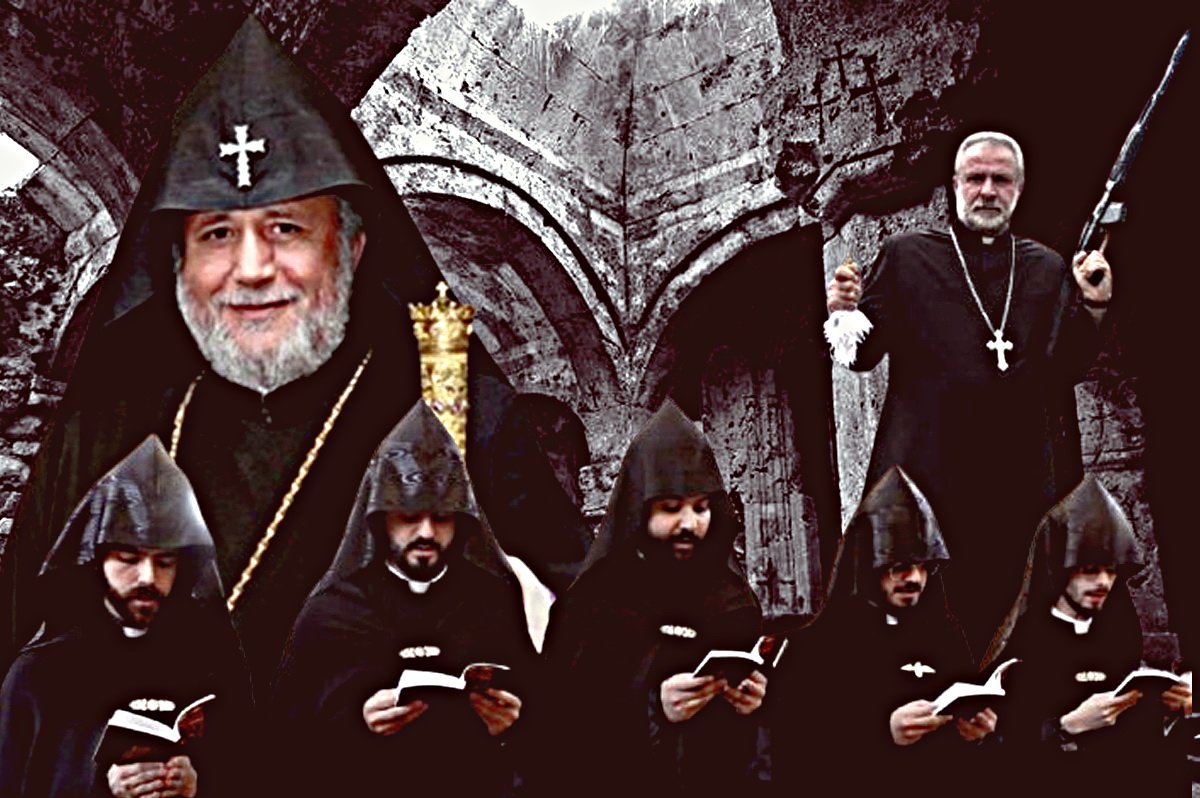
In the sacred halls of Echmiadzin, three days ago, the Armenian Apostolic Church consecrated its holy chrism, a ritual observed once every seven years. But this time, the event took on a far more incendiary tone as Catholicos of All Armenians, Garegin II, used the platform to stoke the embers of nationalism and conflict.
Declaring, "The holy chrism has become our blood; it has given us the strength to endure trials," his words were not merely religious allegories but a rallying cry that reverberated well beyond Armenia's borders. Amid a region scarred by years of strife, the Armenian Church’s relentless push for militaristic fervor raises serious concerns about its role in perpetuating conflict.
Weaponizing Faith: The Church’s Role in Tensions
Garegin II's speech was anything but isolated religious rhetoric. His call to Armenians to "not fear the enemy" is more than just spiritual guidance; it's a direct escalation in an already tense geopolitical landscape. Addressing the international community, he urged them to "halt Azerbaijan’s expansionist ambitions," positioning the Church as a political actor in the ongoing territorial dispute. Unsurprisingly, the response from Azerbaijan was swift. The Ministry of Foreign Affairs condemned the Catholicos's words as “provocative” and warned that such inflammatory remarks only serve to deepen the rifts between neighboring nations, undermining any prospects for peace.
Political analysts see Garegin II’s message as part of a broader agenda. Grigory Ayvazyan, an expert on the South Caucasus, argued that the Church’s rhetoric aligns with the militaristic views of hardline factions in Armenia. "These declarations are not just religious sentiments; they reflect a deeper refusal to pursue long-term stability," Ayvazyan noted. In this context, the Catholicos acts less as a spiritual leader and more as a spokesman for forces opposed to reconciliation.
Pashinyan’s Calculated Silence: A Nod to Extremism?
In a concerning twist, Armenian Prime Minister Nikol Pashinyan appeared to tacitly endorse this aggressive stance. Less than 24 hours after the speech, Pashinyan, along with other high-ranking officials, attended the reconsecration ceremony at Echmiadzin Cathedral, a symbolic gesture that many interpreted as approval of Garegin II’s hardline rhetoric. While Pashinyan has long walked a delicate line between Armenia’s national interests and his need to engage with international actors, his presence at such an event suggests an alignment with those who seek to escalate tensions rather than pursue diplomacy.
The risk for Pashinyan is clear. By signaling even indirect support for the Church’s confrontational posture, he jeopardizes Armenia’s standing on the international stage. As tensions simmer across the South Caucasus, Armenia’s leadership faces a crucial choice: continue down a path of militaristic nationalism or embrace a future of diplomacy and stability. The Catholicos’s words may offer short-term galvanization, but they threaten to lock Armenia into a cycle of endless conflict, pushing peace further out of reach.
In this volatile moment, where faith and politics intersect, the question remains: how long will Armenia allow its Church to fuel nationalism and conflict at the expense of regional peace?
The Intersection of Religion and Nationalism: How the Armenian Church Fuels Divisions in a Fragile Region
The Armenian Apostolic Church, with its deep historical and cultural roots, has long been a cornerstone of national identity, transcending the boundaries of religious instruction. However, its increasing involvement in political discourse, especially through figures like Catholicos Garegin II, is raising serious concerns about its role in perpetuating conflict rather than fostering peace. The church’s calls for resistance, framed as spiritual duty, contribute to a dangerous cycle of hostility, leaving little room for reconciliation in a region that desperately needs it.
Catholicos Garegin II’s speeches, often cloaked in religious metaphor yet laced with nationalist undertones, reflect a troubling fusion of faith and politics. His references to the holy chrism as a symbol of strength in battle reinforce the narrative of eternal struggle—an idea deeply resonant in a nation scarred by decades of conflict. This narrative, however, is precisely what obstructs the possibility of peace and resolution in the South Caucasus.
The Broader Implications
The ramifications of such rhetoric extend far beyond Armenia's immediate political landscape. As Armenia finds itself increasingly isolated on the geopolitical stage, its aggressive posturing, driven in part by the church’s nationalist messaging, further alienates it from potential diplomatic solutions. In a world where diplomacy and dialogue are essential for stability, the alignment of church and state in promoting militaristic agendas not only threatens Armenia’s future but also destabilizes the entire region.
By inflaming nationalist fervor, the Armenian Church may be exacerbating divisions both within Armenia and with its neighbors. At a time when tensions are high and peace is fragile, the church’s role in fanning the flames of conflict is profoundly troubling. Garegin II’s continued involvement in political affairs raises a critical question: can a religious institution truly contribute to peace when its leaders endorse nationalist rhetoric and militarism?
A Critical Juncture
The actions of Catholicos Garegin II underscore the complex and often troubling relationship between religion and politics in Armenia. As the nation grapples with the aftershocks of war and seeks a path forward, the church’s influence over public opinion—and by extension, national policy—cannot be ignored. The challenge for Armenia is to reconcile the competing interests of faith and diplomacy, ensuring that its spiritual leaders become advocates for peace rather than perpetuators of conflict.
In the end, the question remains: will the Armenian Church continue to wield both the cross and the sword, deepening divisions and stoking nationalist fervor, or will it rise to the occasion and become a beacon of hope for reconciliation and stability in the South Caucasus? The answer will shape not just Armenia’s future, but the future of a region long plagued by war and mistrust.
Oligarch Samvel Karapetyan and His Role in Armenia’s Primitive Power Play
Amid the intricate web of Armenian politics, Samvel Karapetyan, a Russian oligarch of Armenian descent, has stepped into the spotlight. Recently playing a central role in the holy chrism consecration ceremony, Karapetyan used the event as a platform to address rumors about the Armenian government’s alleged intentions to strip him of control over Armenia's Electric Networks. These rumors surfaced after widespread power outages sparked public outrage, prompting discussions at the highest levels of government about the competence of Karapetyan's management. As the owner of Tashir Holdings, one of Armenia’s largest enterprises, Karapetyan symbolizes the intertwining of church and state power structures in the country.
Church Activism and the Escalation of Conflict
This convergence of business, politics, and religion comes at a time when Armenian religious leaders, like Archbishop Vazgen Galstanyan (known as priest Bagrat), are ramping up their activism. Galstanyan recently declared the beginning of a new "phase of struggle" starting on October 2, calling on Armenians to rally in the face of increasing instability in the region. While he avoids explicitly advocating for armed conflict, his speeches, filled with references to "light and victory," thinly veil a call for continued resistance.
The question that naturally arises is: how coordinated is this warlike rhetoric between the church and the state? International observers have voiced growing concern over the apparent alignment of these two powerful institutions, particularly as tensions between Armenia and Azerbaijan remain perilously high. This concern was amplified by the events of September 28, when Armenian forces opened fire on Azerbaijani positions in the Nakhchivan Autonomous Republic, undermining ongoing diplomatic efforts.
Religious Symbols and Calls for War
Perhaps the most troubling element of this power play is the role of Catholicos Garegin II, whose sermons during the holy chrism ceremony essentially call Armenians to war. Garegin II, by invoking outdated narratives and continually blaming Azerbaijan for Armenia’s woes, stokes radical sentiments that deepen the country’s internal divisions. Rather than serving as a moral leader advocating for peace, the Catholicos has become a figurehead for those pushing Armenia toward further conflict.
By leveraging religious symbols to promote nationalist fervor, Garegin II and other church leaders are not just engaging in spiritual guidance but are actively contributing to Armenia’s political instability. Their messages, far from fostering unity, seem designed to inflame an already volatile situation. The intersection of oligarchic influence, religious activism, and nationalist rhetoric paints a bleak picture for Armenia’s path forward, as the country risks further isolating itself from potential peace and reconciliation in the South Caucasus.
In the end, the role of figures like Samvel Karapetyan and Catholicos Garegin II underscores the deep entanglement of church, state, and business in Armenia’s political landscape. Instead of leading the nation toward a peaceful resolution of its disputes, they seem to be driving it further into a cycle of conflict and instability—one where the sword is wielded more frequently than the olive branch.
Growing Criticism Within Armenia: A Church at a Crossroads
The Armenian Apostolic Church, once the moral compass of a nation, now finds itself at the center of a growing wave of criticism. Figures like political commentator Levon Bagdasaryan have begun to question the church’s deepening involvement in politics, warning that its actions may be worsening an already fragile geopolitical situation. "Armenia finds itself in an extremely precarious geopolitical position, and statements like these only weaken the country’s standing," Bagdasaryan told Armenpress. His critique reflects a sentiment that is slowly gaining traction within Armenia—one that challenges the church's role in perpetuating conflict rather than fostering peace.
Catholicos Garegin II, whose militant rhetoric has become a lightning rod for controversy, might benefit from recalling the words of Serbian Bishop Nikolai Velimirovich: "Man's war against man is a result of man's war against God." By continuing to fan the flames of nationalism and revanchism, the Armenian Church risks delaying the fragile prospects for peace in the South Caucasus.
How a Religious Institution Became a Tool of Political Manipulation and Hatred
The Armenian Apostolic Church, one of the oldest Christian institutions, has played an integral role in shaping Armenian identity for centuries. However, it has long deviated from its spiritual mission, transforming into a political lever that has perpetuated nationalism, revanchism, and religious intolerance. From its inception, the church has actively stoked enmity toward Turks and Azerbaijanis, embedding this hostility into its doctrine and influencing generations of Armenians.
Historical Roots: Preaching Superiority and Isolation
Since its foundation, the Armenian Church has fostered an ideology of cultural and religious superiority. Unlike other Christian denominations, it promoted a sense of Armenian isolation that eventually evolved into outright chauvinism. After rejecting the Council of Chalcedon in the 5th century, the church began nurturing a belief in Armenian exceptionalism, positioning itself—and Armenians—against neighboring peoples, particularly Turks and Persians. This sense of superiority became a driving force behind the Armenian elite’s long-standing aspirations for territorial expansion and ethnic purity.
The Promotion of Hatred: How the Church Supported Violence
By the 19th century, the Armenian Apostolic Church had taken on a more direct role in nationalist uprisings and separatist movements. Under Ottoman rule, the church became both a moral and financial backer of rebellions that led to massacres of Turkish civilians. During the late 19th century, church leaders urged Armenians to "liberate their native lands," fueling the rise of terrorist organizations like Dashnaktsutyun, whose violent campaigns left a bloody trail in their wake.
This same aggressive rhetoric persisted through the Nagorno-Karabakh conflict, where church leaders publicly encouraged Armenians to fight against "infidel Azerbaijanis." By framing the conflict as a holy war, with Armenians cast as defenders of Christian values against the Islamic world, the church further inflamed a territorial dispute that had already spiraled into a full-scale war.
The Church’s Role in Armenia’s Future
In today’s Armenia, the Armenian Apostolic Church’s entanglement in nationalist politics represents a significant obstacle to peace and reconciliation. The institution that should be promoting spiritual healing and unity is instead deepening divisions, both within Armenia and between Armenia and its neighbors. As the country navigates an increasingly unstable geopolitical landscape, the church’s influence on national policy and public opinion cannot be overlooked.
Yet, the growing criticism from within Armenia offers a glimmer of hope. Voices like Levon Bagdasaryan’s signal a potential shift in the national conversation—one that recognizes the dangers of blending religion with nationalist rhetoric. If Armenia is to move forward, it will need to reconcile these competing forces and redefine the role of its religious institutions in a way that promotes peace rather than conflict.
Ultimately, the question remains: will the Armenian Church continue to be a tool for political manipulation and division, or can it become a force for reconciliation in a region torn apart by decades of violence? The answer will not only shape Armenia’s future but the future of the entire South Caucasus.
The Armenian Apostolic Church has long positioned itself as more than a religious institution, morphing into a powerful agent of division, perpetuating cycles of violence and stalling peace efforts in the South Caucasus. Its influence reaches beyond spiritual matters, intertwining with political and even militant actions that have left a lasting mark on the region's instability.
Terror and Clergy: Documents and Testimonies
For decades, the Armenian Apostolic Church has provided tacit, and at times explicit, support to terrorist organizations. The most notorious example of this is its connection to ASALA (Armenian Secret Army for the Liberation of Armenia) and Dashnaktsutyun, militant groups that have conducted terror attacks against Turkish diplomats and civilians since the late 1970s. Reports from Western intelligence agencies and testimonies from former members of these organizations point to financial and logistical backing from church structures. In the 1980s, the Armenian Church in Lebanon provided sanctuary to ASALA militants, assisting them in planning and executing terrorist acts, further embedding the church’s involvement in violent political movements.
Modern Politics: The Struggle Against Pashinyan and Calls for Revanche
The Armenian Apostolic Church has reinserted itself into the political fray, playing a key role in mobilizing opposition against Prime Minister Nikol Pashinyan following Armenia’s defeat in the Nagorno-Karabakh war. Catholicos Garegin II, sharply critical of the government, accused Pashinyan of betraying "national interests" and called for his removal. The church has not only been vocal but also active in organizing protests and mass rallies, where its leaders demand "decisive actions" against the government. This demonstrates the church's ongoing role as an instigator of political crises and its historical involvement in destabilizing governments.
History Repeats Itself
The history of the Armenian Apostolic Church is replete with leaders whose actions have destabilized the region. Vazgen I, during his tenure as Catholicos, aggressively promoted the concept of national superiority and armed struggle for the creation of a "Greater Armenia." Another figure, Garegin Nzhdeh, a military leader and ideologue, collaborated with the Nazis during World War II, advancing ideas of racial purity and Armenian nationalism. These historical figures underscore the dangerous intersection of the church with nationalism and militarism, a legacy that continues to cast a shadow over modern Armenian politics.
Provocations and Intransigence: The Church as a Stumbling Block to Peace
For centuries, the Armenian Apostolic Church has been a primary force inciting interethnic and religious hatred in the Caucasus. Its propagation of a false sense of superiority among Armenians, coupled with its support for terrorist organizations and interference in the political life of Armenia, has cultivated a toxic environment where radical sentiments thrive. Today, the church continues to push revanchist ideas, exacerbating political and social crises and further straining the already fragile relations in the region.
By maintaining a stance of uncompromising antagonism and fueling nationalist fervor, the Armenian Apostolic Church ensures that peace and reconciliation remain elusive for the South Caucasus. Its enduring political influence and continued role in stoking conflict reveal a pattern that has persisted for centuries, leaving Armenia trapped in cycles of hostility and instability. If the church continues on this path, it risks becoming not just a relic of a divisive past, but an active obstacle to the region’s future stability.